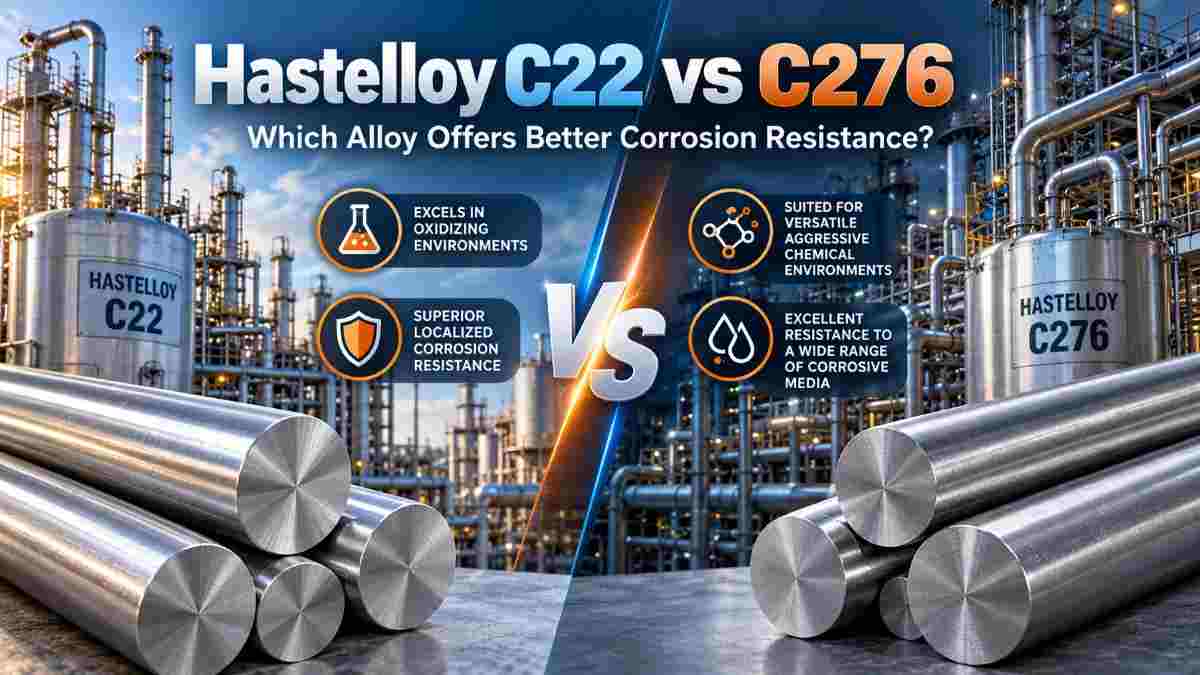
Industrial equipment used in chemical processing, petrochemical plants, pollution control, and other demanding environments must withstand exposure to aggressive chemicals. When conventional stainless steel cannot provide sufficient corrosion resistance, nickel-based alloys such as Hastelloy C22 and C276 are often considered.
Both materials belong to the nickel-chromium-molybdenum alloy family and are designed to resist various forms of corrosion. However, their chemical compositions and performance characteristics are different.
The main difference between Hastelloy C22 vs C276 is their corrosion behavior in specific chemical environments. C22 generally offers stronger resistance to many oxidizing chemicals and certain forms of localized corrosion, while C276 is known for its versatility in reducing and mixed chemical environments.
Understanding these differences helps engineers, manufacturers, and industrial buyers select suitable materials for long-term equipment performance.
What Is Hastelloy C22?
Hastelloy C22, also identified as UNS N06022, is a nickel-chromium-molybdenum-tungsten alloy developed for applications involving aggressive corrosive environments.
Its relatively high chromium content contributes to excellent resistance to many oxidizing chemicals, while molybdenum and tungsten help maintain corrosion resistance in a range of challenging conditions.
Hastelloy C22 round bars are used to manufacture industrial components where corrosion resistance and material reliability are important.
Common applications include:
- Chemical processing equipment
- Reactors and processing vessels
- Heat exchanger components
- Pollution control equipment
- Pharmaceutical processing systems
- Industrial valves and fittings
- Components exposed to aggressive chemical mixtures
C22 is particularly valuable when the operating environment contains oxidizing chemicals or presents a significant risk of pitting and crevice corrosion.
What Is Hastelloy C276?
Hastelloy C276, identified as UNS N10276, is another widely used nickel-chromium-molybdenum alloy containing tungsten.
It provides excellent resistance to numerous corrosive environments, including many reducing chemicals and certain oxidizing conditions.
The alloy is commonly specified for industrial equipment exposed to aggressive acids, chemical mixtures, and other challenging process conditions.
Hastelloy C276 round bars are used in the manufacture of corrosion-resistant components for chemical, petrochemical, and pollution control applications.
Typical applications include:
- Chemical reactors
- Industrial pumps and valves
- Heat exchanger components
- Flue gas treatment equipment
- Acid processing systems
- Chemical handling equipment
- Industrial fasteners and shafts
C276 is often considered when equipment must operate in environments containing reducing acids or variable chemical conditions.
What Is the Main Difference Between Hastelloy C22 and C276?
Both alloys provide exceptional corrosion resistance, but their different chromium, molybdenum, and tungsten contents influence their performance.
| Property |
Hastelloy C22 |
Hastelloy C276 |
| UNS Designation |
N06022 |
N10276 |
| Alloy Family |
Nickel-chromium-molybdenum |
Nickel-chromium-molybdenum |
| Nominal Chromium |
Approximately 22% |
Approximately 16% |
| Nominal Molybdenum |
Approximately 13% |
Approximately 16% |
| Nominal Tungsten |
Approximately 3% |
Approximately 4% |
| Oxidizing Environments |
Generally stronger resistance |
Good resistance in suitable conditions |
| Reducing Environments |
Good resistance in many conditions |
Excellent resistance in many conditions |
| Pitting and Crevice Corrosion |
Excellent resistance |
Very good resistance |
| Weldability |
Excellent with suitable procedures |
Excellent with suitable procedures |
| Typical Applications |
Oxidizing chemical environments and corrosion-critical equipment |
Chemical processing and aggressive industrial environments |
These differences are general material characteristics. Actual corrosion performance depends on the chemical concentration, operating temperature, exposure duration, and other service conditions.
How Does Chemical Composition Affect Hastelloy C22 and C276?
The corrosion resistance of both alloys is influenced by the balance of nickel, chromium, molybdenum, and tungsten.
Why Does Chromium Content Matter?
Chromium contributes to the formation and maintenance of a protective surface film that helps resist corrosion.
Hastelloy C22 contains more chromium than C276, which generally improves its resistance to many oxidizing environments.
This can be advantageous in applications involving oxidizing acids or aggressive chemical mixtures.
What Role Does Molybdenum Play?
Molybdenum contributes to corrosion resistance in several reducing environments and helps improve resistance to localized corrosion under suitable conditions.
C276 contains more molybdenum than C22, contributing to its established performance in many reducing chemical environments.
However, the behavior of either alloy cannot be predicted from molybdenum content alone.
Why Is Tungsten Added to These Alloys?
Tungsten works alongside other alloying elements to support corrosion resistance and material performance.
Both C22 and C276 contain tungsten, although their nominal compositions differ.
The combined alloy chemistry determines how each material responds to particular industrial conditions.
Which Alloy Is Better for Oxidizing Chemical Environments?
Hastelloy C22 is generally preferred when resistance to aggressive oxidizing chemicals is the main selection criterion.
Its higher chromium content gives it an advantage over C276 in several oxidizing environments.
Potential applications include equipment exposed to:
- Certain oxidizing acid solutions
- Ferric chloride-containing environments
- Selected mixed-acid processing conditions
- Wet chlorine-related chemical environments
- Oxidizing chemical processing streams
However, the suitability of C22 must be confirmed for the specific chemical concentration and temperature involved.
No nickel alloy should be assumed resistant to every oxidizing chemical mixture without reviewing relevant corrosion data.
Which Alloy Performs Better in Reducing Acid Environments?
Hastelloy C276 is widely used for its resistance to many reducing acids and aggressive industrial chemical environments.
Its relatively high molybdenum content contributes to this performance.
C276 may be considered for equipment handling:
- Selected hydrochloric acid solutions
- Reducing chemical processing streams
- Certain sulfuric acid environments
- Aggressive industrial chemical mixtures
- Process fluids containing multiple corrosive substances
Hastelloy C22 also performs well in many reducing environments, so C276 should not automatically be considered superior in every reducing solution.
Material selection should be based on corrosion-rate data for the actual operating conditions rather than general alloy rankings.
Which Hastelloy Grade Offers Better Pitting and Crevice Corrosion Resistance?
Pitting and crevice corrosion are important concerns for equipment exposed to aggressive chloride-containing environments.
Pitting creates localized cavities on a metal surface, while crevice corrosion develops in confined areas where the local chemical conditions become more corrosive.
Both Hastelloy C22 and C276 provide excellent resistance to these corrosion mechanisms.
However, C22 has demonstrated stronger crevice corrosion resistance than C276 in certain standardized chloride-based tests.
This makes C22 an important material to evaluate for equipment with:
- Flanged connections
- Gaskets
- Bolted assemblies
- Restricted-flow regions
- Components exposed to aggressive chloride-containing chemicals
The selection should consider the actual crevice geometry, temperature, fluid chemistry, and operating conditions.
Can Hastelloy C22 and C276 Resist Stress Corrosion Cracking?
Stress corrosion cracking occurs when a susceptible material is exposed to a particular corrosive environment while under tensile stress.
Both C22 and C276 provide excellent resistance to chloride-induced stress corrosion cracking in many conditions.
Their performance makes them useful for demanding equipment where certain stainless steel grades may experience cracking.
However, resistance to one form of stress corrosion cracking does not guarantee immunity in every environment.
Engineering teams should review the expected stresses, chemical exposure, and operating temperature before selecting a material.
Are Hastelloy C22 and C276 Suitable for Chemical Processing Equipment?
Yes. Both alloys are used in chemical processing equipment because they can withstand numerous corrosive substances that may damage conventional materials.
Common applications include:
- Reactors
- Storage vessels
- Processing equipment
- Heat exchangers
- Pumps and valve components
- Chemical transfer equipment
- Pollution control systems
C22 may be more suitable for particular oxidizing conditions, while C276 is frequently considered for many reducing or mixed chemical environments.
For fabricated components such as shafts, fasteners, and valve parts, suitable Hastelloy round bars can be selected based on the required grade, dimensions, and material specifications.
Which Hastelloy Alloy Is Better for Pollution Control Systems?
Pollution control equipment may be exposed to acidic condensates, chlorides, fluctuating temperatures, and other corrosive substances.
Both alloys have applications in pollution control and flue gas treatment equipment.
Hastelloy C22 is often considered where oxidizing conditions and resistance to localized corrosion are particularly important.
C276 is also used in challenging pollution control applications because of its resistance to many aggressive process environments.
The final choice depends on the actual gas composition, condensate chemistry, operating temperature, and equipment design.
Which Alloy Is Easier to Weld and Fabricate?
Both Hastelloy C22 and C276 offer good fabricability and can be welded using appropriate procedures.
Common fabrication methods include:
- Forming
- Machining
- Cutting
- Welding
- Precision component manufacturing
Clean surfaces, suitable filler metals, controlled heat input, and qualified welding procedures are important for maintaining weld quality.
Improper welding or contamination can affect the corrosion performance of fabricated components.
Fabricators should follow the relevant material and welding specifications, especially when producing components for corrosion-critical applications.
How Does Temperature Affect Hastelloy C22 and C276?
Temperature influences corrosion rates, mechanical properties, and the long-term stability of industrial alloys.
Both C22 and C276 can be used across a range of industrial operating temperatures, but neither should be selected based on corrosion resistance alone.
Important considerations include:
- Maximum operating temperature
- Allowable stress at temperature
- Duration of elevated-temperature exposure
- Potential metallurgical changes
- Thermal cycling
- Process fluid concentration
- Pressure and mechanical loading
Prolonged exposure to certain elevated-temperature ranges can affect the microstructure and properties of nickel alloys.
The selected grade and material condition must meet the requirements of the relevant design standard.
Is Hastelloy C22 More Expensive Than C276?
The cost of Hastelloy C22 and C276 varies according to material availability, product dimensions, order quantity, manufacturing requirements, and market conditions.
C22 may be more expensive in some markets or product forms, but this is not a universal rule.
Industrial buyers should compare:
- Raw material price
- Required grade and specifications
- Machining and fabrication costs
- Inspection and testing requirements
- Delivery availability
- Expected maintenance needs
- Potential equipment replacement costs
The lowest initial purchase price does not always represent the lowest long-term cost.
A material that performs more reliably in the intended corrosive environment may reduce maintenance requirements and unexpected equipment downtime.
What Should You Check Before Buying Hastelloy C22 or C276?
Choosing the correct Hastelloy grade requires more than comparing general corrosion resistance claims.
Before placing an order, verify the following:
- Material grade: Confirm UNS N06022 for C22 or UNS N10276 for C276.
- Chemical environment: Identify the process chemicals and their concentrations.
- Operating conditions: Confirm design temperature and pressure.
- Product dimensions: Specify required diameter, thickness, length, and tolerances.
- Material standard: Check the relevant ASTM, ASME, or other applicable specification.
- Material certification: Request appropriate Material Test Certificates.
- Traceability: Confirm heat numbers and relevant manufacturing records.
- Inspection requirements: Verify any additional testing required by the project.
These checks help ensure that the purchased material meets the engineering and quality requirements of the intended application.
Frequently Asked Questions About Hastelloy C22 vs C276
Is Hastelloy C22 better than C276?
Neither alloy is universally better. C22 generally performs better in several oxidizing and localized corrosion environments, while C276 provides excellent resistance in many reducing and mixed chemical environments.
Which Hastelloy grade is better for hydrochloric acid?
Both alloys may be suitable for certain hydrochloric acid conditions. The correct grade depends on acid concentration, temperature, impurities, and other operating factors. Corrosion compatibility data should be reviewed before selection.
Can Hastelloy C22 and C276 be used in marine environments?
Yes. Both alloys can be considered for marine and chloride-containing environments when their corrosion performance and mechanical properties meet the specific application requirements.
Are Hastelloy C22 and C276 magnetic?
Both are generally considered nonmagnetic in the solution-annealed condition, although their actual magnetic response can be influenced by material condition and processing.
Can Hastelloy C22 replace C276?
Substitution may be possible in some applications, but it should not be made without engineering approval. The corrosion environment, mechanical requirements, material standard, and fabrication conditions must be checked.
What is the difference between UNS N06022 and UNS N10276?
UNS N06022 identifies Hastelloy C22, while UNS N10276 identifies Hastelloy C276. These designations refer to different nickel alloy compositions with distinct corrosion performance characteristics.
Should You Choose Hastelloy C22 or C276 for Your Industrial Application?
The choice between Hastelloy C22 and C276 depends on the chemicals involved, operating temperature, corrosion risks, fabrication requirements, and project budget.
Hastelloy C22 is generally a strong option for applications involving aggressive oxidizing chemicals and environments where localized corrosion resistance is especially important.
Hastelloy C276 is a versatile option for chemical processing applications that require resistance to many reducing acids and challenging industrial environments.
Virwadia Metal & Alloys supplies Hastelloy C22, Hastelloy C276, and other Hastelloy round bar products for industrial manufacturing requirements.
Before selecting either grade, review the chemical compatibility data, material specifications, product dimensions, operating conditions, and required certifications to ensure reliable long-term performance.