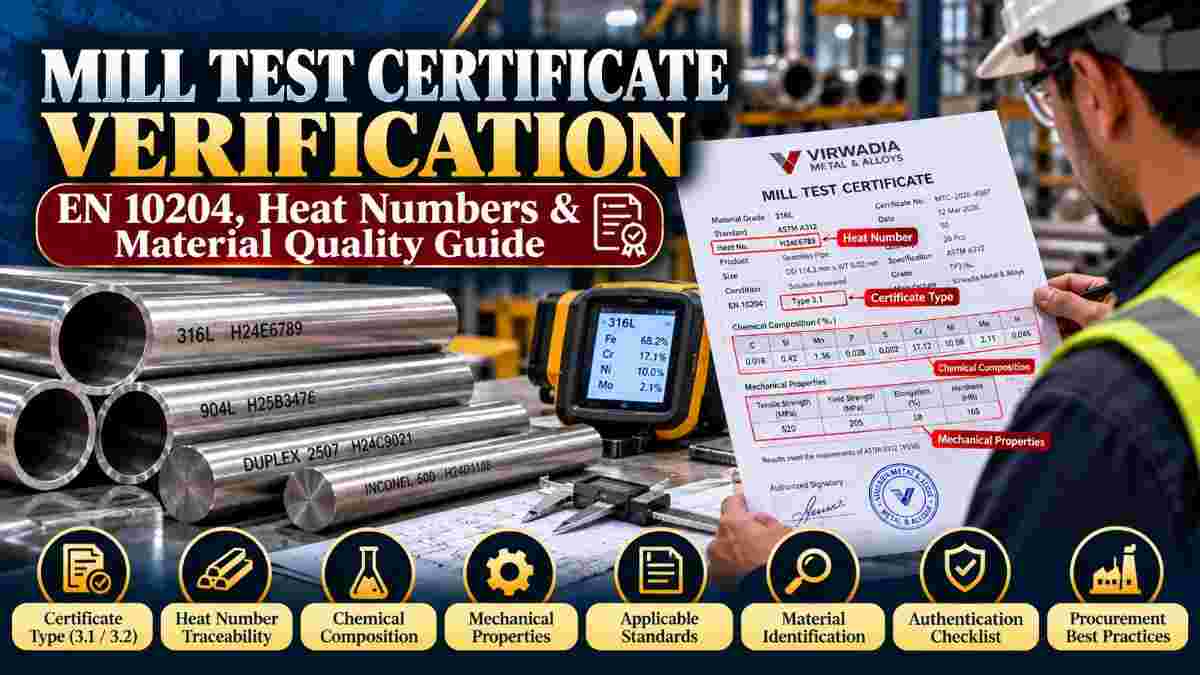
Are you purchasing stainless steel pipes, round bars, plates, or nickel alloy products for an industrial project? Before accepting a shipment, verifying the material documentation is essential.
Mill Test Certificate verification involves checking the manufacturer, material grade, heat number, chemical composition, mechanical properties, applicable standards, and inspection authorization against the purchase order and supplied material.
An incorrect or unverified certificate can create material traceability problems, inspection delays, and procurement risks.
Virwadia Metal & Alloys supplies stainless steel and specialty alloy products for industrial applications.
This guide explains how buyers can review material certificates and identify potential discrepancies before accepting a delivery.
What Is a Mill Test Certificate?
A Mill Test Certificate (MTC) is a document reporting material identification, inspection information, and test results associated with a manufactured metal product or batch.
Depending on the specification, an MTC may contain:
The exact information depends on the certificate type, product specification, and purchase requirements.
Why Is Mill Test Certificate Verification Important?
MTC verification helps buyers establish whether the supplied material can be traced to documented manufacturing and inspection records.
It is particularly important for:
-
Chemical processing equipment.
-
Pressure-containing components.
-
Petrochemical applications.
-
Industrial piping.
-
Heat exchangers.
-
Critical mechanical components.
-
High-performance nickel alloy products.
A certificate is useful only when its information corresponds to the actual material supplied.
What Is the Difference Between EN 10204 Type 3.1 and 3.2 Certificates?
EN 10204 Type 3.1 and 3.2 both contain results from specific inspection, but they differ in who validates the certificate.
What Is an EN 10204 Type 3.1 Certificate?
A Type 3.1 certificate is validated by the manufacturer's authorized inspection representative, who is independent of the manufacturing department.
It reports specific inspection results and a statement of compliance with the order.
What Is an EN 10204 Type 3.2 Certificate?
A Type 3.2 certificate requires validation by the manufacturer's authorized inspection representative and an additional authorized inspector.
That additional inspector represents the purchaser or is designated by applicable regulations.
Type 3.2 does not automatically mean the material has better mechanical properties than material supplied with Type 3.1 documentation.
The required document type should be specified before procurement.
How Do You Check the Heat Number on a Mill Test Certificate?
Verify that the heat number recorded on the certificate corresponds to the identification markings and traceability documents for the delivered material.
Follow these steps:
-
Locate the heat number on the certificate.
-
Inspect the material markings.
-
Compare the identification numbers.
-
Review packing and delivery records.
-
Confirm traceability after cutting or processing.
-
Investigate missing or inconsistent identifiers.
A matching number is important, but it does not independently prove that a document is authentic.
How Do You Verify Stainless Steel Chemical Composition?
Compare the reported chemical analysis with the permitted composition limits of the specified material grade and product standard.
Relevant elements may include:
For nickel alloys, additional alloying elements may be important.
For example, a buyer ordering 316L stainless steel should verify its chemical results against the applicable specification for that grade.
Do not rely only on the grade name printed at the top of the certificate.
How Do You Check Mechanical Test Results?
Mechanical test results should be compared with the requirements of the applicable product standard, material condition, and purchase specification.
Common properties include:
Requirements vary by material and product form.
For precipitation-hardening stainless steel, mechanical properties may depend significantly on the heat-treatment condition.
Nickel alloy requirements may also differ between annealed and other specified supply conditions.
How Can You Verify the ASTM Material Specification?
Confirm that the ASTM specification, edition, material grade, and product form on the certificate match the purchase order.
For example:
-
ASTM A312 covers specified stainless steel pipes.
-
ASTM A213 covers specified seamless boiler and heat-exchanger tubes.
-
ASTM A269 covers stainless steel tubing for general service.
These standards have different scopes and requirements.
Explore Stainless Steel Seamless Pipes and Stainless Steel Seamless Tubes for relevant products.
How Can You Identify a Potentially Incorrect or Unreliable MTC?
Potential warning signs include inconsistent heat numbers, missing manufacturer information, incorrect standards, unexplained test results, and certificates that cannot be authenticated.
Check for:
-
Missing material identification.
-
Conflicting product descriptions.
-
Incorrect grade designations.
-
Unexplained alterations.
-
Missing required test results.
-
Incomplete authorization.
-
Certificate details that do not match the shipment.
These issues require investigation rather than automatically proving that a document is fraudulent.
Can You Verify a Mill Test Certificate With the Manufacturer?
Yes. Where possible, contact the original producing mill or authorized certification source to confirm the certificate's authenticity.
Provide the relevant certificate reference and heat number.
For additional assurance, buyers may also request:
-
Original mill documentation.
-
Verified traceability records.
-
Third-party inspection.
-
Independent material testing.
Additional testing should be selected according to the project requirements.
Is Positive Material Identification the Same as MTC Verification?
No. Positive Material Identification (PMI) is a material analysis method, while MTC verification reviews documentary inspection and traceability evidence.
PMI may help identify the presence of certain alloying elements.
However, the capability of a particular PMI method depends on the instrument and elements being measured.
For example, conventional XRF-based PMI generally cannot accurately determine carbon content.
Therefore, PMI alone cannot establish every material-grade requirement or replace a valid inspection certificate.
What Should Buyers Include in an MTC Verification Checklist?
A practical MTC checklist should cover material identity, traceability, test results, certificate authorization, and purchase-order compliance.
Verify:
-
Manufacturer's identity.
-
Certificate number.
-
EN 10204 document type.
-
ASTM or applicable material standard.
-
Material grade and UNS designation.
-
Heat or cast number.
-
Product dimensions.
-
Chemical composition.
-
Mechanical properties.
-
Heat-treatment condition.
-
Required supplementary tests.
-
Authorized certificate validation.
-
Delivery documentation.
-
Physical material traceability.
Record any discrepancy before accepting the material.
Why Should Buyers Consider Virwadia Metal & Alloys?
Virwadia Metal & Alloys offers stainless steel and specialty alloy products for industrial purchasing requirements.
Its product portfolio includes stainless steel pipes, tubes, round bars, duplex steel, super duplex materials, and nickel alloys.
Buyers can discuss the applicable material standards, inspection requirements, and documentation needed for their orders.
The availability of specific certificate types and additional testing should be confirmed before purchase.
What Are the Most Frequently Asked Questions About Mill Test Certificates?
Buyers commonly ask about certificate types, heat numbers, authenticity, and inspection requirements.
Is an MTC Mandatory for Every Stainless Steel Product?
Not universally. Documentation requirements depend on the contract, product standard, regulations, and intended application.
What Is the Difference Between MTC 3.1 and 3.2?
Type 3.1 is validated by the manufacturer's authorized inspection representative independent of production. Type 3.2 adds validation by a qualifying additional inspector.
Can a Mill Test Certificate Be Fake?
Yes, documents can be falsified or incorrectly associated with material. Authentication and traceability checks help reduce this risk.
Does a Matching Heat Number Prove Material Quality?
No. It supports traceability but does not replace verification of test results, specification compliance, or document authenticity.
Can PMI Replace an MTC?
No. PMI provides analytical information about selected elements but does not replace the complete documentation and testing requirements.
How Can You Request Certified Stainless Steel and Nickel Alloys?
You can request material quotations by specifying the grade, product dimensions, applicable standard, quantity, and required inspection documentation.
Before ordering, confirm whether EN 10204 Type 3.1, Type 3.2, or another documentation arrangement is required.
Explore Stainless Steel Seamless Pipes, Stainless Steel Seamless Tubes, or contact Virwadia Metal & Alloys to discuss material sourcing and documentation requirements.
Technical Note: Material certificate verification should follow the applicable product specification, purchase order, project quality plan, and regulatory requirements.