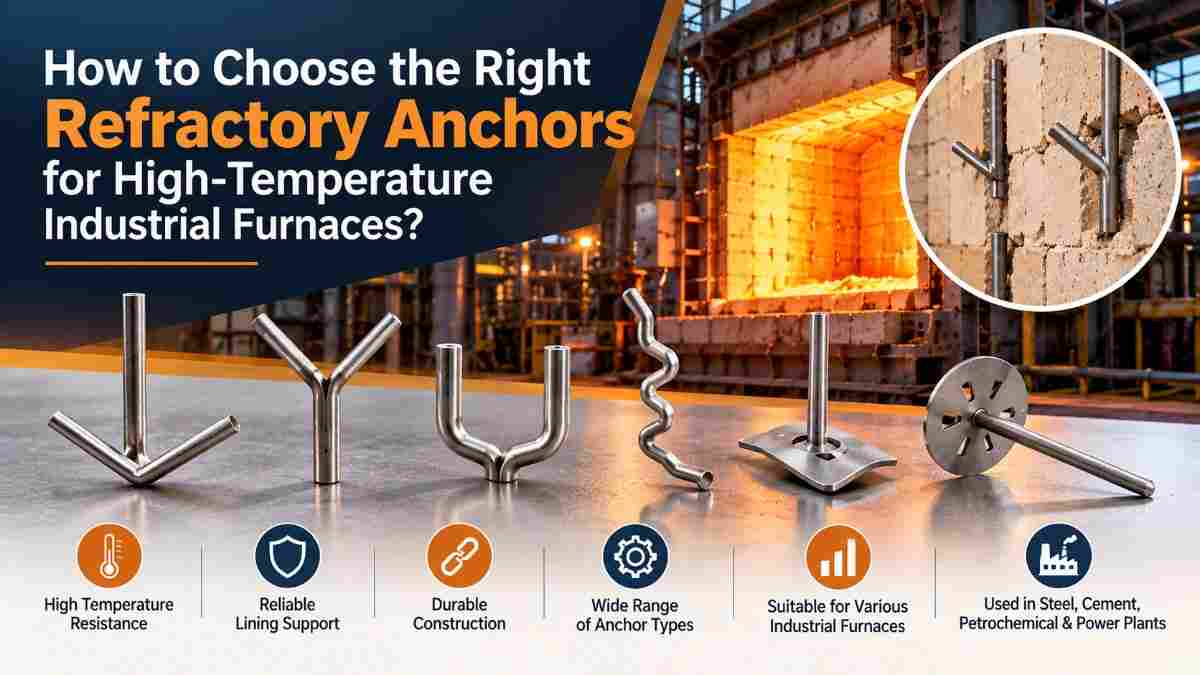
Industrial furnaces, kilns, boilers, and heat treatment equipment operate under demanding conditions where high temperatures, thermal expansion, and mechanical stress can affect the performance of refractory linings.
Refractory anchors play an important role in keeping these linings securely attached to the supporting structure. However, selecting an anchor based only on its shape or material grade may result in premature deterioration, lining damage, or unexpected maintenance requirements.
The right refractory anchor depends on several factors, including operating temperature, refractory lining thickness, anchor material, equipment design, thermal cycling, and installation conditions.
Understanding these requirements helps industrial buyers, engineers, and maintenance teams select suitable anchoring systems for reliable furnace operation.
What Are Refractory Anchors and Why Are They Important?
Refractory anchors are metallic or ceramic components used to support and secure refractory linings in high-temperature industrial equipment.
They help hold refractory materials in position and transfer appropriate mechanical loads to the supporting structure.
In many industrial installations, refractory linings are exposed to continuous heating, cooling, vibration, and process-related forces. Without a properly designed anchoring arrangement, the lining may crack, become detached, or lose structural stability.
Refractory anchors are used in equipment such as:
- Industrial furnaces
- Rotary kilns
- Boilers and combustion chambers
- Heat treatment equipment
- Petrochemical processing units
- Incinerators
- Cement manufacturing equipment
- Steel processing furnaces
The selected anchor must be compatible with both the refractory lining and the operating conditions of the equipment.
What Are the Different Types of Refractory Anchors?
Refractory anchors are available in different shapes and configurations. Each design provides a different method of supporting refractory materials.
The choice depends on lining thickness, equipment orientation, mechanical loading, and the refractory installation method.
What Are V-Type Refractory Anchors Used For?
V-type refractory anchors are commonly used to secure castable refractory linings to furnace walls and other supporting surfaces.
Their two-arm configuration helps distribute support within the refractory material.
They are frequently considered for:
- Furnace walls
- Industrial ducts
- Boiler linings
- Heat treatment equipment
- General castable refractory installations
V-type anchors must be selected according to the lining design, expected loading, and installation requirements.
When Should You Choose Y-Type Refractory Anchors?
Y-type refractory anchors have a branched design that can provide additional mechanical engagement within a refractory lining.
They may be suitable for thicker linings or installations where additional support is required.
Potential applications include furnace roofs, walls, and equipment exposed to significant mechanical or thermal stresses.
However, the suitability of a Y-type anchor must be confirmed through the specific lining design rather than its shape alone.
How Do U-Type Refractory Anchors Work?
U-type anchors are used in certain refractory and insulation support arrangements where their geometry is compatible with the installation requirements.
They can provide support for designated lining systems, depending on how they are attached and embedded.
The correct application depends on the refractory material, supporting structure, and design specifications.
What Are Stud and Pin Anchors Used For?
Stud and pin anchors are commonly considered for certain insulation and relatively thin refractory lining applications.
They may be welded or otherwise attached to the supporting structure, depending on the equipment design.
Some lining systems also use retaining clips, washers, or other components to secure insulation materials.
The complete fastening arrangement should be selected according to the lining system and service conditions.
How Do You Choose the Right Refractory Anchor Material?
Material selection is one of the most important decisions when choosing refractory anchors for industrial furnaces.
The anchor material must withstand the expected metal temperature, mechanical loading, thermal cycling, and chemical environment.
Common material options include stainless steel and selected nickel-based alloys.
When Are SS 304 Refractory Anchors Suitable?
Stainless Steel 304 provides good corrosion resistance, weldability, and fabrication characteristics for many industrial applications.
SS 304 anchors may be suitable for applications where the expected anchor temperature and environmental conditions remain within the material's allowable limits.
They can be considered for selected insulation systems, lower-temperature furnace zones, and other industrial installations.
However, SS 304 should not automatically be selected for very high-temperature service because prolonged heat exposure can reduce mechanical strength and affect material performance.
Why Are SS 310 Refractory Anchors Used in High-Temperature Furnaces?
Stainless Steel 310 contains higher levels of chromium and nickel than SS 304, providing improved oxidation resistance in many elevated-temperature environments.
This makes SS 310 an important material option for refractory anchors used in furnaces, kilns, and heat treatment systems.
It is commonly considered when the expected anchor temperature exceeds the practical operating range of conventional SS 304 anchors.
However, its suitability still depends on the actual metal temperature, atmosphere, mechanical loading, and duration of heat exposure.
When Should You Consider Inconel Refractory Anchors?
Inconel alloys are nickel-based materials used in selected high-temperature and corrosion-resistant applications.
Depending on the specific alloy grade, Inconel anchors may provide useful resistance to oxidation, corrosion, or demanding thermal conditions.
They may be considered for:
- Specialized industrial furnaces
- Petrochemical processing equipment
- High-temperature combustion systems
- Equipment exposed to aggressive atmospheres
- Applications requiring specific elevated-temperature properties
Different Inconel grades provide different performance characteristics. The exact alloy must be selected according to the operating environment and relevant engineering requirements.
What Is the Difference Between SS 304, SS 310, and Inconel Anchors?
The three material categories differ in their compositions, elevated-temperature properties, corrosion resistance, and costs.
| Feature |
SS 304 Anchors |
SS 310 Anchors |
Inconel Anchors |
| Material Family |
Austenitic stainless steel |
Heat-resistant austenitic stainless steel |
Nickel-based alloy |
| Heat Resistance |
Suitable for selected moderate-temperature conditions |
Improved high-temperature oxidation resistance |
Varies by alloy; certain grades suit demanding heat exposure |
| Corrosion Resistance |
Good in compatible environments |
Good in suitable high-temperature environments |
Varies by alloy and chemical conditions |
| Weldability |
Generally good |
Generally good with suitable procedures |
Depends on the specific alloy |
| Relative Cost |
Generally economical |
Usually higher than SS 304 |
Often higher, depending on grade |
| Typical Selection |
Selected lower-temperature applications |
Elevated-temperature furnace service |
Specialized demanding environments |
These comparisons are general. The actual allowable temperature and mechanical performance must be verified using the relevant alloy data and equipment design conditions.
How Does Furnace Temperature Affect Refractory Anchor Selection?
Temperature directly affects the mechanical strength, oxidation behavior, and expected service life of metallic refractory anchors.
An important distinction is that the temperature experienced by an embedded anchor may be different from the furnace operating temperature.
The refractory lining creates a temperature gradient between the hot face and the supporting structure.
Therefore, engineers should estimate the maximum temperature experienced by the anchor, particularly near its hottest embedded section.
Important factors include:
- Furnace operating temperature
- Maximum design temperature
- Refractory lining thickness
- Thermal conductivity of the lining
- Anchor length and embedded depth
- Furnace atmosphere
- Heating and cooling frequency
- Expected service duration
Selecting anchor material based only on furnace temperature can lead to an unsuitable design.
The material must be evaluated for its estimated operating temperature and the mechanical stresses it will experience.
How Important Is Refractory Lining Thickness?
Refractory lining thickness influences anchor length, positioning, load distribution, and exposure to heat.
An anchor that is too short may not provide adequate support, while an excessively long metallic anchor may experience greater heat exposure or create unwanted stresses.
The correct anchor dimensions depend on:
- Type of refractory material
- Total lining thickness
- Single-layer or multilayer construction
- Installation orientation
- Mechanical loading
- Thermal expansion allowance
Anchor embedment depth should be determined by the lining designer or the relevant refractory system specification.
A standard anchor length should not be assumed suitable for every furnace installation.
How Do You Determine the Correct Spacing Between Refractory Anchors?
Anchor spacing affects the distribution of the refractory lining's weight and its ability to remain secured during operation.
If anchors are positioned too far apart, sections of the lining may lack adequate support.
However, excessive anchoring can increase installation costs and may introduce additional thermal stresses if expansion is not properly considered.
The required spacing depends on:
- Refractory lining density
- Lining thickness
- Wall or roof orientation
- Equipment geometry
- Operating temperature
- Vibration and mechanical impact
- Anchor shape and dimensions
- Manufacturer or engineering design requirements
There is no single spacing arrangement suitable for all refractory installations.
The anchor layout should follow an approved refractory lining design rather than a generalized spacing recommendation.
Why Is Thermal Expansion Important for Refractory Anchors?
Metallic anchors and refractory materials expand and contract at different rates when exposed to temperature changes.
Repeated heating and cooling can create stresses around the anchor and within the refractory lining.
If the anchoring system does not accommodate these movements, localized cracking or lining damage may occur.
Depending on the lining design, engineering solutions may involve suitable anchor geometry, expansion allowances, protective anchor caps, or other specified details.
The selected method must remain compatible with the operating temperature and refractory material.
What Causes Refractory Anchors to Fail?
Refractory anchor failure may occur because of unsuitable material selection, incorrect installation, or operating conditions beyond the intended design.
Common causes include:
- Incorrect material grade: The alloy cannot withstand the expected operating conditions.
- Excessive temperature: Prolonged heat exposure reduces strength or causes accelerated oxidation.
- Improper spacing: The anchor arrangement does not adequately support the lining.
- Incorrect embedment: Anchor length or placement creates insufficient support or excessive thermal stress.
- Welding defects: Poor attachment reduces the reliability of the support system.
- Thermal cycling: Repeated expansion and contraction contribute to fatigue or lining damage.
- Corrosive environments: Aggressive gases or chemical deposits attack the anchor material.
- Mechanical stress: Vibration, impact, or equipment movement exceeds the anchoring system's capacity.
Addressing these risks during design and installation can help improve the reliability of industrial refractory systems.
How Should Refractory Anchors Be Installed?
Proper installation is essential for maintaining the performance of refractory linings.
Depending on the anchor system, installation may involve welding, mechanical attachment, or other approved fastening methods.
Important installation considerations include:
- Correct anchor material and dimensions
- Clean supporting surfaces
- Approved welding or attachment procedures
- Specified anchor spacing
- Correct orientation and embedment
- Suitable thermal expansion provisions
- Inspection before refractory placement
- Compliance with the approved lining design
Qualified personnel should carry out installation and inspection according to the project specifications.
Where additional securing components are required, suitable refractory fasteners should be selected according to the lining system and equipment requirements.
Which Industries Commonly Use Refractory Anchors?
Refractory anchors are widely used in industries that operate high-temperature equipment.
How Are Refractory Anchors Used in Steel Plants?
Steel manufacturing facilities use refractory linings in furnaces, ladles, reheating equipment, and other thermal systems.
Anchoring systems may be required for specific monolithic refractory installations, depending on equipment design.
Why Are Refractory Anchors Important in Cement Plants?
Cement plants operate kilns, preheaters, calciners, and other equipment exposed to elevated temperatures and abrasive process conditions.
Correctly designed anchors help support refractory linings in selected equipment sections.
Where Are Refractory Anchors Used in Petrochemical Plants?
Petrochemical processing facilities may require refractory anchoring systems in fired heaters, reactors, ducts, and combustion-related equipment.
The selected material must be compatible with the expected temperature, atmosphere, and mechanical conditions.
How Are Refractory Anchors Used in Power Plants?
Power generation facilities use refractory linings in selected boilers, combustion chambers, ducts, and thermal equipment.
The anchoring system must provide appropriate support while accommodating the operational temperature changes.
What Should You Check Before Buying Refractory Anchors?
Before purchasing refractory anchors, industrial buyers should prepare the technical specifications required by the installation.
Important details include:
- Material grade: Confirm the specified stainless steel or nickel alloy.
- Anchor design: Identify the required V-type, Y-type, U-type, stud, or other configuration.
- Dimensions: Specify diameter, thickness, width, and length as applicable.
- Operating conditions: Provide the expected temperature and environmental exposure.
- Lining details: Confirm the refractory material and thickness.
- Attachment method: Identify the required welding or mechanical fastening arrangement.
- Material specifications: Confirm the applicable standards for the alloy and product form.
- Documentation: Request relevant material certifications and traceability records.
- Quantity: Calculate requirements according to the approved anchor layout.
Providing complete technical requirements helps reduce incorrect material orders, installation problems, and project delays.
Frequently Asked Questions About Refractory Anchors
Which stainless steel grade is best for refractory anchors?
The best grade depends on the expected anchor temperature, furnace atmosphere, and mechanical requirements. SS 304 may suit selected lower-temperature applications, while SS 310 is commonly considered for more demanding high-temperature environments.
What is the difference between V-type and Y-type refractory anchors?
V-type and Y-type anchors have different geometries and mechanical engagement characteristics. Their suitability depends on lining thickness, orientation, expected loading, and refractory system design.
Can refractory anchors withstand temperatures above 1000°C?
Some anchor materials and designs are suitable for elevated temperatures, but the allowable service conditions depend on the exact material, stress, atmosphere, and exposure duration. Metallic and ceramic anchors have different limitations.
Are Inconel anchors better than stainless steel anchors?
Not in every application. Certain Inconel grades provide advantages in demanding high-temperature or corrosive environments, but stainless steel anchors can be more economical when their properties meet the engineering requirements.
How long do refractory anchors last?
Service life depends on material selection, actual operating temperature, corrosion exposure, thermal cycling, installation quality, and mechanical loading. There is no universal service-life figure for all refractory anchor systems.
Can damaged refractory anchors be reused?
Damaged or severely deteriorated anchors should not be reused without a qualified engineering assessment. Replacement is generally necessary when the anchor cannot safely provide its intended support.
How Can You Choose the Right Refractory Anchors for Long-Term Furnace Performance?
Choosing refractory anchors requires careful consideration of material grade, anchor geometry, lining thickness, operating temperature, and installation conditions.
SS 304 anchors may be suitable for selected moderate-temperature applications, while SS 310 and appropriate nickel-based alloys can be considered for more demanding high-temperature environments.
The correct anchor type, spacing, and attachment method should be determined according to the approved refractory lining design.
Virwadia Metal & Alloys supplies refractory anchors, stainless steel anchors, and refractory fastening products for different industrial requirements.
Before selecting a product, review the equipment operating conditions, material specifications, anchor dimensions, and project documentation. A properly selected anchoring system can help support refractory lining reliability, reduce maintenance risks, and improve the long-term performance of industrial furnaces.