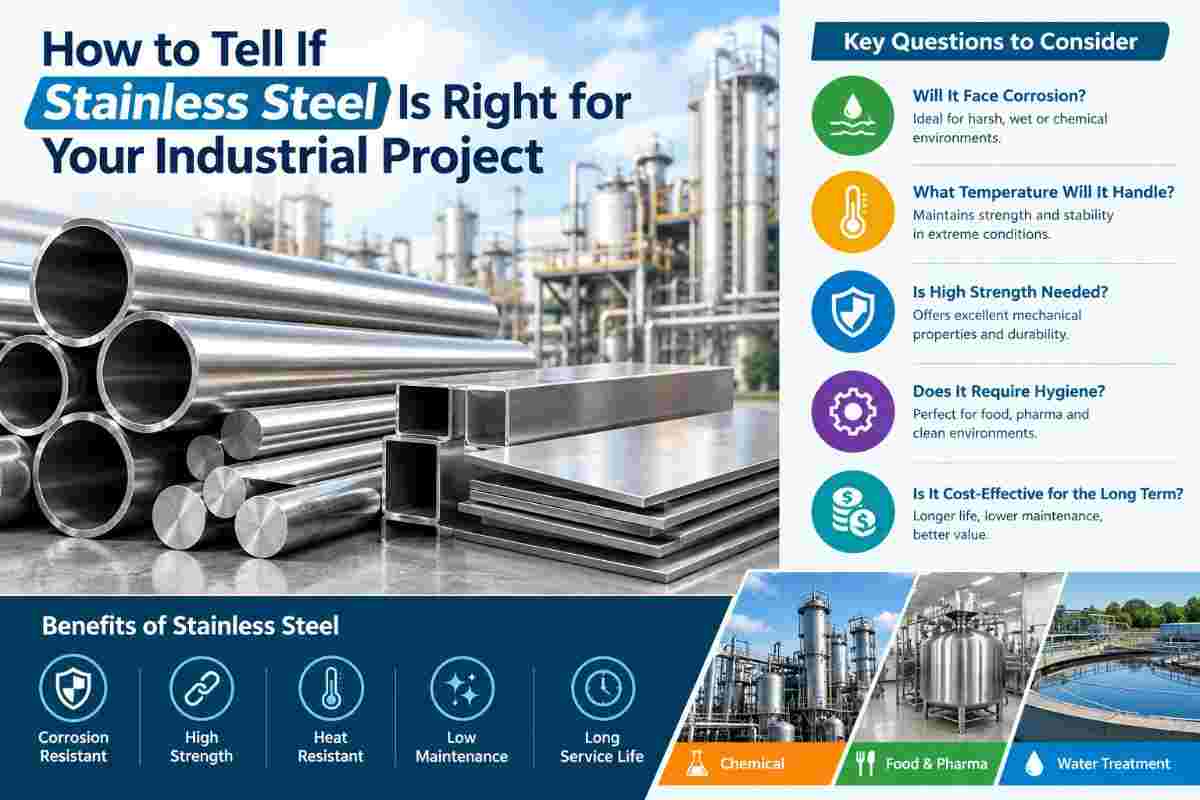
Stainless steel is right for your industrial project if your application needs corrosion resistance, good strength at your operating temperature, hygiene or easy cleaning, and a long service life with low maintenance. It is a poor fit when the environment is extremely aggressive (hot concentrated acids, high-chloride seawater at temperature), when weight is the main concern, or when a cheaper material will last the project's full life.
Choosing the wrong material leads to early corrosion, unplanned shutdowns, and costly replacement. This guide gives you a practical checklist to decide whether stainless steel suits your project, and which grade to pick if it does.
What Makes Stainless Steel Different?
Stainless steel is an iron alloy with at least 10.5% chromium. The chromium forms a thin, self-repairing oxide layer on the surface that protects the metal from rusting. Adding nickel, molybdenum, nitrogen or titanium changes its strength, heat resistance and corrosion behaviour. That is why stainless steel is a family of materials, not a single one.
7 Questions to Ask Before You Choose Stainless Steel
1. What environment will the material operate in?
Corrosion is the most common reason to choose stainless steel, so start here.
- Mild or indoor conditions (food processing, architecture, dry storage): Grade 304 usually works well.
- Chloride exposure (coastal sites, marine, salt-laden process water, chemical plants): Grade 316 or 316L, which contains molybdenum, resists pitting much better.
- Highly aggressive media (hot acids, severe chlorides, offshore): Consider 904L, duplex, or super duplex.
Rule of thumb: If your environment contains chlorides, acids, or both, never assume a standard grade is enough. Confirm the exact concentration, temperature and pH with your supplier.
2. What are the operating temperatures?
Stainless steel performs across a wide range, but grades differ:
- Cryogenic and low temperatures: Austenitic grades such as 304 and 316 stay tough even at very low temperatures.
- High temperatures: Grades like 310 / 310S are widely used in furnaces and heat-treatment equipment because of their oxidation resistance at very high temperatures. For extreme heat plus corrosion, nickel alloys such as Inconel may be more suitable.
- Mid-range with chlorides: Be careful. Austenitic grades can suffer stress corrosion cracking in warm chloride environments, and duplex grades are often the better choice.
3. How much mechanical strength do you need?
If you need higher strength without increasing wall thickness, look beyond 304/316:
- Duplex and super duplex grades (e.g., UNS S31803, S32205, S32750) offer significantly higher yield strength than standard austenitic grades, so you can often use thinner sections.
- Precipitation-hardening grades (17-4 PH, 15-5 PH) combine high strength with good corrosion resistance, common in shafts, valves and aerospace parts.
- Martensitic grades (410, 420) can be heat-treated for hardness and wear resistance, but resist corrosion less well.
4. Do hygiene or cleanability matter?
Stainless steel's smooth, non-porous surface is easy to clean and sterilize. This makes it a standard choice in pharmaceutical, food, beverage and dairy applications. If your project has sanitary requirements, stainless steel is usually the safest option.
5. What does the full lifecycle cost look like?
Stainless steel costs more upfront than carbon steel, but that is only part of the picture. Compare:
- Initial material and fabrication cost
- Coatings, painting and repair costs (carbon steel needs these, stainless often doesn't)
- Downtime and replacement frequency
- Expected service life
For long-life or hard-to-access installations, stainless steel often works out cheaper over its lifetime. For short-term or low-risk uses, a cheaper material may be the smarter choice.
6. Can you fabricate and weld it properly?
Stainless steel is highly weldable and formable, but it needs correct procedures. Low-carbon grades (304L, 316L) reduce the risk of sensitization in welded structures. Free-machining grades (303, 430F) suit CNC-turned parts. Confirm your fabrication method before finalizing a grade.
7. Are there standards or documentation requirements?
Many projects, especially in oil & gas, power and petrochemicals, require material to meet standards such as ASTM, ASME, API, DIN or EN, along with traceability. Always ask for Mill Test Certificates (MTC) per EN 10204 so you can verify chemistry and mechanical properties.
Quick Comparison: Which Stainless Steel Grade Fits Your Application?
| Application Need |
Suggested Grade Family |
Why |
| General fabrication, tanks, food equipment |
304 / 304L |
Good corrosion resistance, easy to fabricate, economical |
| Chemical, marine or chloride exposure |
316 / 316L / 317L |
Molybdenum improves pitting resistance |
| High-temperature furnaces and heaters |
310 / 310S / 321 / 347 |
Oxidation and heat resistance |
| High strength plus corrosion resistance |
Duplex / Super Duplex |
Higher strength, better stress corrosion resistance |
| Severe acids |
904L / SMO 254 |
High nickel and molybdenum content |
| Shafts, valves, aerospace parts |
17-4 PH / 15-5 PH |
High strength after heat treatment |
| Wear and hardness (blades, cutting parts) |
410 / 420 / 431 |
Hardenable martensitic grades |
This table is a general guide. Final selection should be confirmed against your actual operating conditions.
When Stainless Steel May NOT Be the Right Choice
Being honest about limits builds better projects:
- Extreme chemical or thermal conditions may need nickel alloys such as Inconel, Hastelloy or Monel, or titanium.
- Weight-critical designs might be better served by aluminium or titanium.
- Very low-budget, short-life structures in non-corrosive settings may not justify the premium.
- Wrong grade selection is the biggest risk. Using 304 where 316 is needed can lead to early failure.
A Simple 5-Step Decision Process
- Define the environment: chemicals, chlorides, humidity, pH.
- Define the load: pressure, mechanical stress, temperature range.
- Match to a grade family using the table above.
- Check standards, certification and fabrication method.
- Confirm with your supplier and request MTCs before ordering.