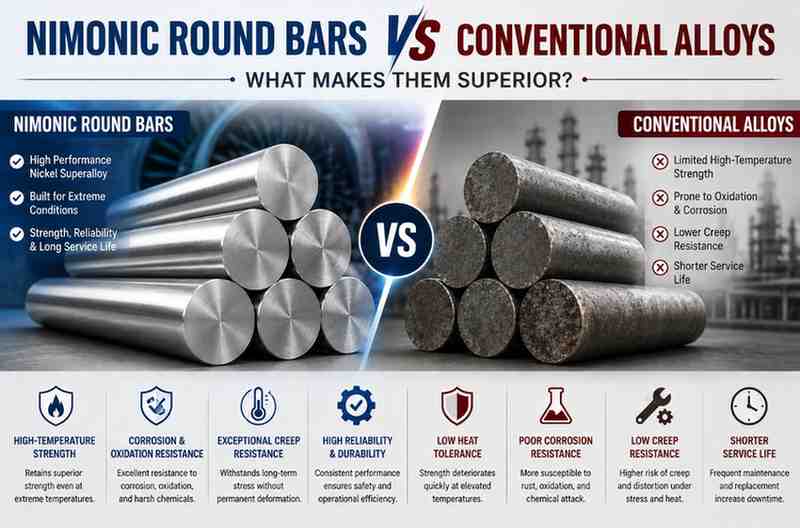
In industries where extreme temperatures, high mechanical stress, and corrosive environments are everyday challenges, selecting the right material is critical. Aerospace manufacturers, power generation facilities, gas turbine producers, and chemical processing plants all require materials that can perform reliably under demanding operating conditions.
Among the many high-performance materials available today, Nimonic Round Bars have earned a reputation for exceptional strength, heat resistance, and long-term durability. While conventional alloys continue to serve a wide range of industrial applications, they often struggle when exposed to extreme temperatures and aggressive environments.
This raises an important question: What makes Nimonic Round Bars superior to conventional alloys?In this guide, Virwadia Metal & Alloys explores the key differences between Nimonic alloys and traditional metal alloys, helping engineers, procurement professionals, and manufacturers make informed material selection decisions.
Understanding Nimonic Round Bars
Nimonic is a family of nickel-chromium-based superalloys specifically developed for high-temperature applications. These alloys are engineered to maintain their strength and structural integrity even under prolonged exposure to elevated temperatures.
Unlike conventional steel alloys, Nimonic materials offer exceptional resistance to:
- High-temperature oxidation
- Thermal fatigue
- Creep deformation
- Corrosion
- Mechanical stress
As a result, Nimonic Round Bars are widely used in critical applications where failure is not an option.
Suggested Internal Link: Nimonic Round Bars
What Are Conventional Alloys?
Conventional alloys typically include materials such as:
- Carbon Steel
- Alloy Steel
- Stainless Steel
- Low-Alloy Steel
These materials provide excellent performance for many industrial applications. However, their mechanical properties can deteriorate significantly when subjected to extreme temperatures and harsh operating environments.
While conventional alloys are cost-effective and versatile, they may not always meet the performance requirements of advanced engineering sectors.
Suggested Internal Link: Stainless Steel Round Bars
Nimonic Round Bars vs Conventional Alloys: Performance Comparison
1. High-Temperature Strength
One of the most significant advantages of Nimonic Round Bars is their ability to retain strength at elevated temperatures.
Conventional alloys often experience strength reduction and deformation when exposed to prolonged heat. Nimonic alloys, however, are specifically designed to maintain mechanical stability under such conditions.
This makes them ideal for:
- Gas turbines
- Jet engines
- Heat treatment equipment
- Power generation systems
Winner: Nimonic Round Bars
2. Superior Creep Resistance
Creep occurs when materials slowly deform under continuous stress and high temperatures.
In applications where components operate for thousands of hours, creep resistance becomes a critical performance factor.
Nimonic alloys offer outstanding creep resistance, significantly outperforming conventional alloys and ensuring longer service life.
Winner: Nimonic Round Bars
3. Corrosion and Oxidation Resistance
Industrial environments often expose materials to:
- High temperatures
- Moisture
- Chemicals
- Oxidizing atmospheres
Conventional alloys can experience accelerated degradation under these conditions.
Nimonic Round Bars provide exceptional oxidation and corrosion resistance, helping maintain performance even in aggressive environments.
For applications requiring additional corrosion resistance, industries also utilize Nickel Alloy Round Bars and Hastelloy Round Bars.
Suggested Internal Links:
- Nickel Alloy Round Bars
- Hastelloy Round Bars
4. Mechanical Reliability
When safety and reliability are critical, material performance becomes a major concern.
Nimonic alloys maintain their:
- Tensile strength
- Fatigue resistance
- Impact resistance
- Structural stability
Even under extreme operating conditions, they continue to perform consistently, making them a preferred choice for aerospace and energy industries.
Winner: Nimonic Round Bars
5. Thermal Stability
Repeated heating and cooling cycles can cause conventional alloys to weaken over time.
Nimonic alloys are specifically engineered to withstand thermal cycling without significant property degradation.
This characteristic makes them particularly valuable in turbine engines and high-temperature manufacturing processes.
Winner: Nimonic Round Bars
6. Service Life
Longer component life translates directly into:
- Reduced maintenance costs
- Lower replacement expenses
- Improved operational efficiency
- Increased equipment reliability
Nimonic Round Bars often provide significantly longer service life compared to conventional alloys operating in similar environments.
Although the initial investment may be higher, the long-term savings can be substantial.
Winner: Nimonic Round Bars
Why Aerospace Industries Prefer Nimonic Round Bars
Aerospace applications demand materials capable of operating under extreme conditions.
Nimonic Round Bars are commonly used in:
- Turbine blades
- Combustion chambers
- Exhaust systems
- Engine components
- Fasteners and structural parts
Their exceptional strength-to-weight ratio and high-temperature performance make them indispensable in modern aerospace engineering.
For specialized aerospace and marine applications, manufacturers may also use Titanium Round Bars and Inconel Round Bars alongside Nimonic materials.
Suggested Internal Links:
- Titanium Round Bars
- Inconel Round Bars
Applications Where Nimonic Outperforms Conventional Alloys
Aerospace Industry
Nimonic alloys help maintain engine efficiency and reliability at extreme operating temperatures.
Power Generation
Gas turbines and power plant components benefit from superior heat resistance and long-term durability.
Chemical Processing
Excellent corrosion resistance ensures reliable performance in aggressive chemical environments.
Marine Engineering
Specialized high-performance components require materials capable of resisting corrosion and mechanical stress.
Oil and Gas Industry
Critical equipment exposed to harsh operating conditions benefits from the enhanced properties of Nimonic alloys.
Cost vs Performance: Is Nimonic Worth the Investment?
At first glance, conventional alloys may appear more economical due to their lower initial cost.
However, when evaluating:
- Maintenance costs
- Downtime expenses
- Component replacement frequency
- Operational reliability
- Equipment lifespan
Nimonic Round Bars often deliver superior long-term value.
For industries where equipment failure can result in substantial losses, investing in premium-performance alloys is a strategic decision rather than an expense.
How Nimonic Compares with Other High-Performance Alloys
While Nimonic excels in high-temperature applications, other advanced alloys are also used for specialized requirements:
- Inconel Round Bars for extreme heat and corrosion resistance
- Monel Round Bars for marine and chemical environments
- Hastelloy Round Bars for highly corrosive applications
- Titanium Round Bars for lightweight strength and corrosion resistance
Each material offers unique advantages, and selecting the right alloy depends on the specific application requirements.
Suggested Internal Links:
- Inconel Round Bars
- Monel Round Bars
- Hastelloy Round Bars
- Titanium Round Bars
Why Choose Virwadia Metal & Alloys?
Virwadia Metal & Alloys is committed to supplying premium-quality alloy products that meet the demanding requirements of modern industries.
Our extensive product portfolio includes:
- Nimonic Round Bars
- Inconel Round Bars
- Monel Round Bars
- Hastelloy Round Bars
- Nickel Alloy Round Bars
- Titanium Round Bars
- Stainless Steel Round Bars
With a focus on quality, reliability, and customer satisfaction, we help industries source materials that deliver exceptional performance and long-term value.
Conclusion
When comparing Nimonic Round Bars with conventional alloys, the advantages are clear. Superior high-temperature strength, exceptional creep resistance, enhanced corrosion protection, and longer service life make Nimonic alloys the preferred choice for critical industrial applications.
While conventional alloys remain suitable for many standard applications, industries operating in extreme environments require materials capable of delivering reliable performance without compromise.
By choosing high-quality Nimonic Round Bars from Virwadia Metal & Alloys, businesses can improve operational efficiency, reduce maintenance costs, and ensure long-term reliability in even the most demanding conditions.