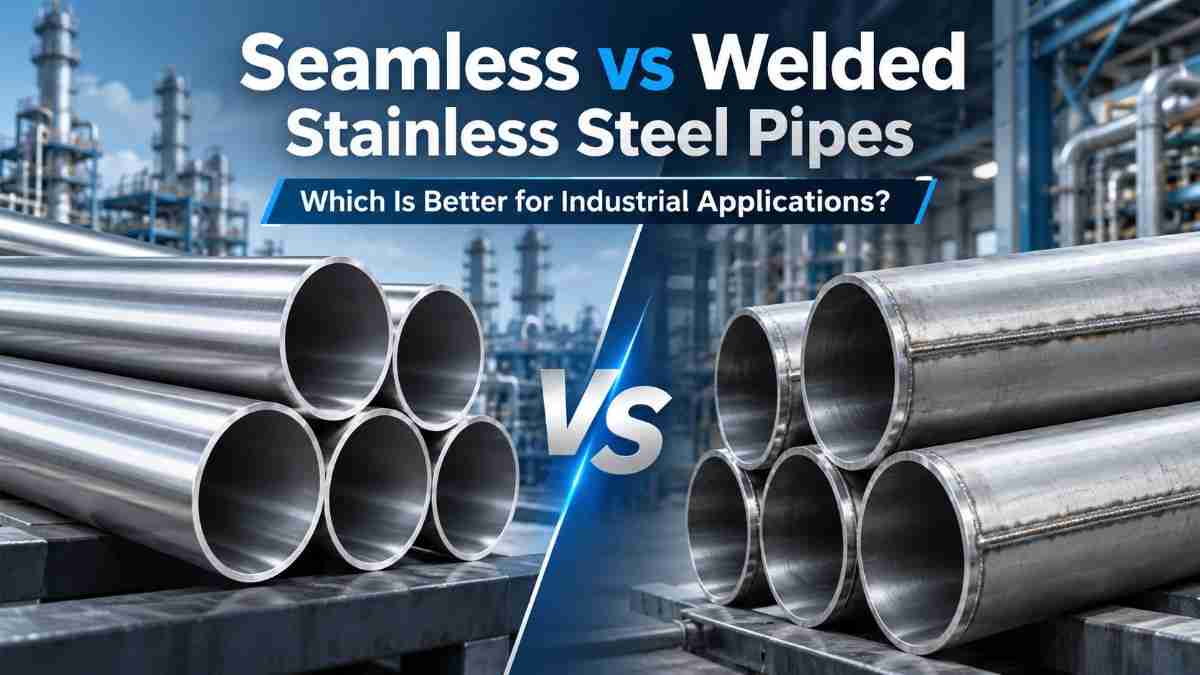
Choosing the right stainless steel pipe is an important decision for industries that handle liquids, gases, chemicals, and high-temperature processes. Two commonly used options are seamless and welded stainless steel pipes. Although both can provide reliable performance, their manufacturing methods, costs, available dimensions, and suitability for specific operating conditions are different.
The choice between seamless vs welded stainless steel pipes depends on factors such as operating pressure, temperature, corrosion exposure, material grade, dimensional requirements, and project budget.
Understanding these differences can help manufacturers, engineers, and industrial buyers select suitable piping materials without compromising operational safety or spending more than necessary.
What Are Seamless Stainless Steel Pipes?
Seamless stainless steel pipes are manufactured without a longitudinal welded seam. They are generally produced by piercing a solid billet and processing it into a hollow pipe through hot or cold working methods.
Because there is no longitudinal weld, seamless pipes are frequently considered for demanding applications where pressure containment, material consistency, and applicable piping specifications are important.
Stainless steel seamless pipes are available in different grades, sizes, and wall thicknesses for industrial requirements.
Common applications include:
- Oil and gas processing systems
- Petrochemical pipelines
- High-pressure fluid transportation
- Boilers and heat exchangers
- Power generation equipment
- Chemical processing facilities
- Industrial process piping
However, seamless construction alone does not determine the maximum pressure or temperature a pipe can withstand. Material grade, dimensions, manufacturing standard, and operating conditions must also be considered.
What Are Welded Stainless Steel Pipes?
Welded stainless steel pipes are generally manufactured by forming stainless steel strips, plates, or coils into a tubular shape and joining their edges through a welding process.
Depending on the manufacturing method and specification, the welded seam may undergo additional finishing, inspection, and testing to ensure the pipe meets the intended service requirements.
Stainless steel welded pipes are used across many industrial applications because they can offer a practical combination of availability, dimensional options, and cost efficiency.
Typical applications include:
- Water distribution systems
- Industrial fluid transportation
- Food and beverage processing equipment
- Pharmaceutical processing systems
- General industrial pipelines
- Fabrication and structural applications
- Low- and moderate-pressure process systems
Properly manufactured and qualified welded pipes can also be used in demanding pressure applications when permitted by the applicable design code and material specification.
What Is the Main Difference Between Seamless and Welded Stainless Steel Pipes?
The primary difference lies in how the pipes are manufactured.
Seamless pipes are produced without a longitudinal welded joint, whereas welded pipes are formed from stainless steel material and joined along a seam.
This manufacturing difference influences production costs, available sizes, inspection requirements, and suitability for particular engineering applications.
| Feature |
Seamless Stainless Steel Pipes |
Welded Stainless Steel Pipes |
| Manufacturing |
Produced without a longitudinal weld |
Produced by forming and welding metal |
| Weld Seam |
No longitudinal seam |
Contains a welded seam |
| Pressure Applications |
Commonly specified for demanding pressure services |
Suitable for pressure services within applicable code and specification limits |
| Cost |
Generally higher for comparable common sizes |
Often more economical |
| Size Availability |
Depends on production and mill capabilities |
Often offers a broad range of larger diameters |
| Inspection |
Requires applicable material and pipe testing |
Requires applicable material, weld, and pipe testing |
| Applications |
Process piping, boilers, and demanding industrial services |
Process piping, fluid transportation, and fabrication |
Neither pipe type is automatically better for every application. The correct selection depends on engineering specifications and how the piping system will operate.
Which Pipe Is Better for High-Pressure Applications?
Seamless stainless steel pipes are often selected for high-pressure services because their construction eliminates the longitudinal weld seam.
However, it would be incorrect to assume that every seamless pipe has a higher pressure rating than every welded pipe.
Pressure capacity depends on several factors:
- Pipe outside diameter
- Wall thickness
- Stainless steel grade
- Allowable material stress at operating temperature
- Manufacturing specifications
- Applicable piping design code
- Weld joint quality factors, where applicable
- Corrosion allowance
Modern welded pipes manufactured and inspected to appropriate standards can also provide reliable pressure containment.
For critical applications, engineering teams should calculate the required wall thickness and verify that the selected pipe complies with the relevant design code.
Do Seamless Pipes Offer Better Corrosion Resistance Than Welded Pipes?
Corrosion resistance depends primarily on the stainless steel grade, service environment, surface condition, and manufacturing quality rather than the presence or absence of a welded seam alone.
For example, stainless steel 304 is widely used in general industrial environments, while 316L is often considered where improved resistance to certain chloride-containing or corrosive environments is required.
Welded pipes may need appropriate welding procedures, weld inspection, and post-weld surface treatment to maintain corrosion performance around the welded area.
Seamless pipes avoid longitudinal weld-related concerns, but they can still experience pitting, crevice corrosion, stress corrosion cracking, or other damage under unsuitable operating conditions.
When corrosion resistance is a priority, buyers should evaluate the intended fluid, chemical concentration, temperature, and material grade.
For applications requiring 316L material, explore stainless steel 316L seamless pipes and review their suitability against the project specifications.
Which Stainless Steel Pipe Is More Cost-Effective?
Welded stainless steel pipes are often more economical than seamless pipes of comparable grades and dimensions because their production processes can be more efficient for many common sizes.
However, the actual price difference depends on:
- Stainless steel grade
- Pipe diameter
- Wall thickness
- Manufacturing process
- Order quantity
- Surface finish
- Inspection and testing requirements
- Market availability
Seamless pipes may justify their additional cost when the project requires their construction method or specific performance characteristics.
Welded pipes can offer better purchasing value when they meet all technical requirements at a lower total cost.
Industrial buyers should therefore compare compliant pipe options rather than making a decision based only on the initial material price.
Are Seamless or Welded Pipes Better for High-Temperature Applications?
Both seamless and welded stainless steel pipes can be used in high-temperature environments when manufactured from suitable materials and designed according to the applicable standards.
Important selection factors include:
- Maximum operating temperature
- Continuous or intermittent heat exposure
- Allowable stress at temperature
- Oxidation and scaling resistance
- Thermal expansion
- Creep strength for prolonged high-temperature service
- Pressure and mechanical loading
Some high-temperature installations specify seamless pipes because of design requirements, inspection criteria, or operating conditions.
However, an appropriately designed and qualified welded pipe can also be suitable for high-temperature applications.
The material grade and applicable engineering specifications should guide the final selection.
Which Stainless Steel Grades Are Commonly Used for Industrial Pipes?
Different stainless steel grades provide different combinations of corrosion resistance, mechanical properties, and temperature performance.
Why Is Stainless Steel 304 Commonly Used?
Stainless steel 304 is a widely used austenitic stainless steel grade suitable for many general industrial piping applications.
It provides good corrosion resistance in a range of environments and is commonly used in processing equipment, fabrication, and fluid-handling systems.
Buyers looking for this material can review stainless steel 304 seamless pipes for relevant product information.
When Should You Consider Stainless Steel 316L?
Stainless steel 316L contains molybdenum and has a low carbon content, making it useful for applications that require improved resistance to certain corrosive environments and reduced susceptibility to sensitization during welding.
It is frequently specified for chemical processing, pharmaceutical equipment, and other applications where its material characteristics are required.
However, 316L is not immune to chloride corrosion, and its suitability must be evaluated for the specific operating conditions.
What About Stainless Steel 310 and Other Heat-Resistant Grades?
Heat-resistant stainless steel grades may be specified for high-temperature systems where oxidation resistance and elevated-temperature mechanical performance are important.
The selection should be based on the actual service temperature, pressure, exposure conditions, and relevant material specifications.
Can Welded Stainless Steel Pipes Be Used in Food and Pharmaceutical Industries?
Yes. Welded stainless steel pipes and tubes are used in food, beverage, and pharmaceutical applications when they meet the required hygienic, material, surface finish, and fabrication standards.
In these industries, the internal surface condition and cleanability can be just as important as the manufacturing process.
Buyers should consider:
- Required material grade
- Internal surface roughness
- Weld quality and finishing
- Cleaning and sterilization requirements
- Applicable hygienic standards
- Material traceability
- Inspection and documentation
For applications involving precision tubing, manufacturers may also evaluate stainless steel welded tubes according to the intended process requirements.
How Do You Choose the Right Pipe for Your Industrial Project?
Selecting between seamless and welded stainless steel pipes becomes easier when the project requirements are clearly defined before purchasing.
Start with the following considerations:
- Operating pressure: Identify the maximum design pressure and relevant code requirements.
- Operating temperature: Consider both normal and maximum design temperatures.
- Corrosion exposure: Evaluate the fluids, chemicals, and surrounding environment.
- Pipe dimensions: Confirm outside diameter, wall thickness, and required length.
- Material grade: Select the stainless steel grade according to process and mechanical requirements.
- Applicable standards: Specify the required ASTM, ASME, or other relevant material and design specifications.
- Inspection requirements: Determine whether additional testing or third-party inspection is necessary.
- Project budget: Compare the total cost of pipe options that meet the same engineering requirements.
Consulting the project's engineering specifications and obtaining suitable material documentation can reduce the risk of selecting an unsuitable pipe.
What Should You Check Before Buying Seamless or Welded Stainless Steel Pipes?
Before placing an industrial pipe order, verify the technical details and documentation provided by the supplier.
Important checks include:
- Correct stainless steel grade
- Applicable material specification
- Nominal pipe size or outside diameter
- Specified wall thickness or schedule
- Dimensional tolerances
- Required surface condition
- Material Test Certificate (MTC)
- Heat number and traceability information
- Applicable inspection and testing reports
- Delivery quantity and required lengths
For welded pipes, additional attention may be required for the welding process, seam inspection, and any supplementary testing specified by the project.
Confirming these details before purchasing helps ensure that the supplied products match the intended industrial application.
Frequently Asked Questions About Seamless and Welded Stainless Steel Pipes
Are seamless stainless steel pipes stronger than welded pipes?
Not necessarily. Seamless pipes have no longitudinal weld, but overall strength and pressure capacity depend on material grade, dimensions, manufacturing quality, and applicable design standards.
Are welded stainless steel pipes suitable for pressure applications?
Yes. Welded pipes can be suitable for pressure applications when manufactured, inspected, and selected according to the applicable material specifications and piping design codes.
Which pipe type is generally more expensive?
Seamless stainless steel pipes are often more expensive than comparable welded pipes, although prices vary according to grade, dimensions, specifications, and market conditions.
Do welded pipes have lower corrosion resistance?
Not inherently. Corrosion performance depends on the material grade, service environment, welding quality, and surface treatment. Properly manufactured welded pipes can provide reliable corrosion resistance.
Can seamless and welded pipes be used in the same industrial facility?
Yes. Industrial facilities commonly use different pipe types across separate systems depending on pressure, temperature, fluid characteristics, and engineering requirements.
Should You Choose Seamless or Welded Stainless Steel Pipes?
The better choice depends on the intended application rather than the manufacturing method alone.
Seamless stainless steel pipes are commonly considered for demanding pressure and process applications, especially where the project specifications require seamless construction.
Welded stainless steel pipes may offer a more economical solution for a wide range of industrial applications when they meet the required technical and safety standards.
Virwadia Metal & Alloys supplies stainless steel seamless and welded pipe products for a variety of industrial requirements. Buyers can explore available materials and specifications to identify suitable options for their projects.
Before making a final decision, compare the operating conditions, required material grade, dimensional specifications, inspection requirements, and overall project costs to select a pipe system that delivers reliable long-term performance.