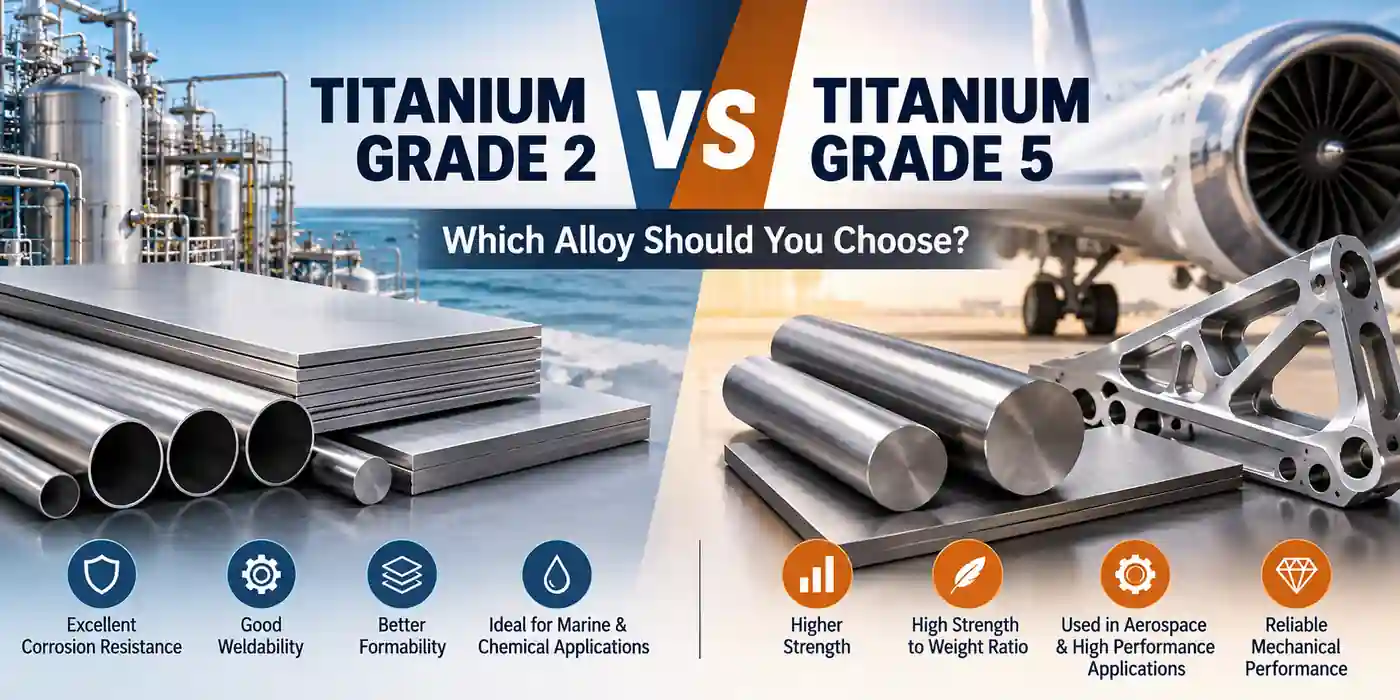
Titanium is widely used in industries where corrosion resistance, low weight, and reliable mechanical performance are important. However, not all titanium grades offer the same properties. Two commonly specified materials are Titanium Grade 2 and Titanium Grade 5.
The main difference between Titanium Grade 2 vs Grade 5 is their composition and strength. Grade 2 is commercially pure titanium known for its corrosion resistance, ductility, and weldability. Grade 5 is a titanium alloy containing aluminum and vanadium, offering significantly higher strength for demanding engineering applications.
Both materials are used in industrial manufacturing, but selecting the wrong grade can increase costs, complicate fabrication, or result in unsuitable performance.
Understanding their mechanical properties, corrosion behavior, manufacturing requirements, and applications can help engineers and industrial buyers choose the appropriate material.
What Is Titanium Grade 2?
Titanium Grade 2 is a commercially pure titanium material containing a high percentage of titanium and controlled amounts of elements such as iron and oxygen.
It provides a useful combination of corrosion resistance, moderate strength, ductility, and fabrication flexibility. These characteristics make it suitable for equipment exposed to seawater, industrial chemicals, and certain corrosive processing environments.
Titanium Grade 2 is commonly considered for applications that require dependable corrosion resistance without the higher strength of an alloyed titanium grade.
Typical applications include:
- Chemical processing equipment
- Heat exchangers
- Desalination equipment
- Marine components
- Industrial tanks and vessels
- Process piping and tubing
- Equipment exposed to compatible corrosive fluids
Grade 2 is particularly useful when the equipment design prioritizes corrosion resistance, formability, and weldability over maximum tensile strength.
What Is Titanium Grade 5?
Titanium Grade 5, also known as Ti-6Al-4V, is an alpha-beta titanium alloy containing approximately 6% aluminum and 4% vanadium.
These alloying elements substantially increase its mechanical strength compared with commercially pure titanium grades.
Grade 5 is frequently selected for components that must withstand significant mechanical loads while maintaining a relatively low weight.
Titanium Grade 5 is used in engineering applications where a high strength-to-weight ratio and suitable corrosion resistance are required.
Common applications include:
- Aerospace structural components
- Aircraft engine components within approved operating limits
- Precision engineering parts
- High-strength fasteners
- Automotive performance components
- Marine engineering components
- Industrial machinery parts
- Medical devices manufactured to applicable material specifications
Although Grade 5 offers much higher strength, it is not automatically the most suitable or economical choice for every application.
What Is the Main Difference Between Titanium Grade 2 and Grade 5?
The most important differences involve their chemical composition, mechanical strength, formability, fabrication requirements, and cost.
| Property |
Titanium Grade 2 |
Titanium Grade 5 |
| Material Type |
Commercially pure titanium |
Alpha-beta titanium alloy |
| Composition |
Predominantly titanium |
Titanium with approximately 6% aluminum and 4% vanadium |
| Tensile Strength |
Approximately 345 MPa minimum |
Approximately 895 MPa minimum in common annealed product specifications |
| Yield Strength |
Approximately 275 MPa minimum |
Approximately 828 MPa minimum in common annealed product specifications |
| Density |
Approximately 4.51 g/cm³ |
Approximately 4.43 g/cm³ |
| Formability |
Generally easier to form |
More demanding to form |
| Weldability |
Generally good with proper shielding |
Weldable with controlled procedures |
| Corrosion Resistance |
Excellent in many compatible environments |
Good in many environments, but condition-dependent |
| Typical Cost |
Generally lower |
Generally higher |
| Common Applications |
Chemical, marine, and process equipment |
Aerospace and high-strength engineering components |
The mechanical values shown are representative minimum values for commonly specified mill products. Actual requirements vary by product form, material standard, thickness, and heat-treatment condition.
Which Titanium Grade Offers Better Strength?
Titanium Grade 5 offers significantly higher tensile and yield strength than Titanium Grade 2.
This makes Grade 5 suitable for applications where components must carry substantial loads while remaining lightweight.
For example, aerospace components, high-strength bolts, and precision-engineered structural parts may benefit from the strength-to-weight ratio of Grade 5.
Grade 2 provides lower mechanical strength but offers greater ductility and is often easier to form into industrial components.
When selecting a grade for a load-bearing application, engineers should consider:
- Tensile strength
- Yield strength
- Fatigue resistance
- Component geometry
- Operating temperature
- Expected mechanical loading
- Applicable design safety factors
If high mechanical strength is the primary requirement, Grade 5 is usually the stronger candidate. If the component operates under moderate loads and requires easier fabrication, Grade 2 may be more practical.
Is Titanium Grade 2 More Corrosion-Resistant Than Grade 5?
Both grades provide good corrosion resistance in many environments because titanium forms a protective oxide layer on its surface.
However, their corrosion performance is not identical under every condition.
Commercially pure Titanium Grade 2 is frequently preferred for chemical processing, desalination, and seawater-handling applications due to its established corrosion performance in many compatible environments.
Titanium Grade 5 also provides good resistance to several corrosive environments, but its alloy composition and metallurgical condition can influence its behavior.
Important considerations include:
- Chemical composition of the process fluid
- Operating temperature
- Fluid concentration
- Presence of chlorides or other aggressive substances
- Crevice conditions
- Potential galvanic interactions
- Exposure duration
Neither grade is resistant to every chemical or industrial environment. Certain reducing acids, fluoride-containing solutions, and other aggressive conditions can damage titanium.
For corrosion-critical applications, material selection should be based on verified compatibility data and the actual service conditions.
Which Titanium Grade Is Better for Marine Applications?
Titanium Grade 2 is widely used in marine and seawater-related equipment because of its corrosion resistance and practical fabrication properties.
It is commonly considered for seawater heat exchangers, desalination systems, piping, and related equipment.
Grade 5 may be selected for marine components that require higher mechanical strength, such as specialized fasteners and load-bearing parts.
The choice depends on whether corrosion resistance, mechanical loading, fabrication, or a combination of these factors is the primary design requirement.
For example, Grade 2 may be suitable for heat-transfer tubing, while Grade 5 may be more appropriate for a mechanically stressed component operating in a compatible marine environment.
Is Titanium Grade 5 Better for Aerospace Components?
Titanium Grade 5 is widely used in aerospace engineering because of its high strength-to-weight ratio and mechanical performance.
Compared with Grade 2, it can support higher mechanical loads without requiring the same component dimensions in applications where the design permits.
Aerospace applications may include:
- Structural brackets
- Aircraft fasteners
- Engine-related components
- Machined aerospace parts
- Load-bearing assemblies
However, aerospace applications require strict control over material specifications, product condition, testing, and traceability.
Grade 5 should only be selected when its properties meet the relevant component design and certification requirements.
Which Titanium Grade Is Easier to Weld?
Titanium Grade 2 is generally easier to weld than Grade 5 because of its commercially pure composition and favorable ductility.
Both materials require proper welding practices to prevent contamination from atmospheric oxygen, nitrogen, and hydrogen at elevated temperatures.
Important welding considerations include:
- Appropriate inert gas shielding
- Clean welding surfaces
- Suitable filler material
- Qualified welding procedures
- Heat input control
- Protection of the heated weld area during cooling
Grade 5 is weldable, but its higher-strength alloy composition makes welding procedure qualification and post-weld performance considerations particularly important.
For fabricated tanks, vessels, and process equipment, Grade 2 may offer practical advantages when the required mechanical strength is moderate.
Is Titanium Grade 2 Easier to Machine Than Grade 5?
Titanium machining can be challenging because the material has relatively low thermal conductivity and can generate concentrated heat at the cutting tool.
Grade 2 generally offers lower cutting resistance because of its lower strength, although its ductility and tendency to adhere to tools can create machining difficulties.
Grade 5 is harder and stronger, which can increase tool loading and require carefully controlled machining conditions.
Machining performance depends on:
- Tool material and geometry
- Cutting speed
- Feed rate
- Coolant application
- Workpiece condition
- Machine rigidity
- Component design
Neither grade should be treated as easy to machine without appropriate tooling and process planning.
Which Titanium Grade Is Better for Chemical Processing Equipment?
Titanium Grade 2 is often preferred for chemical processing equipment where corrosion resistance, fabricability, and reliable service performance are more important than maximum material strength.
Applications may include:
- Chemical storage and processing vessels
- Heat exchangers
- Process piping
- Cooling systems
- Reactor components
- Desalination equipment
Grade 5 may be considered for high-strength mechanical parts used within processing equipment, provided its corrosion behavior and mechanical properties are suitable.
For chemical service, the actual process medium and operating conditions should determine the material selection.
How Does Temperature Affect Titanium Grade 2 and Grade 5?
Temperature can significantly influence the strength, corrosion behavior, and long-term performance of titanium materials.
Grade 2 is commonly selected for corrosion-resistant process equipment operating within its approved temperature limits.
Grade 5 can retain useful mechanical strength at elevated temperatures, but its suitability depends on the material condition, duration of exposure, and design requirements.
Important factors include:
- Maximum design temperature
- Allowable stress at temperature
- Oxidation behavior
- Potential embrittlement
- Long-term creep performance
- Thermal cycling
Neither grade should be selected for sustained high-temperature applications without reviewing the applicable engineering data and design standard.
Is Titanium Grade 5 More Expensive Than Grade 2?
Titanium Grade 5 is generally more expensive than Grade 2 because of its alloy composition, processing requirements, and the manufacturing controls associated with high-strength applications.
However, actual pricing depends on several factors:
- Material grade
- Product form
- Dimensions and thickness
- Heat-treatment condition
- Order quantity
- Required certifications
- Machining and finishing requirements
- Supplier availability
Using Grade 5 where Grade 2 can meet all project requirements may increase material and fabrication costs unnecessarily.
On the other hand, selecting Grade 2 for a component that requires Grade 5 strength could create serious performance or safety concerns.
The most economical material is the one that satisfies the engineering requirements at an appropriate total cost.
What Titanium Product Forms Are Available for Industrial Applications?
Titanium is supplied in different forms depending on the manufacturing process and intended application.
Common product forms include:
- Titanium round bars and rods
- Titanium sheets
- Titanium plates
- Titanium pipes and tubes
- Titanium fasteners
- Custom-machined titanium components
Industrial buyers can explore the available titanium products offered by Virwadia Metal & Alloys to review material grades and product options.
The required product form should be specified along with the grade, dimensions, material standard, and intended operating conditions.
What Should You Check Before Buying Titanium Grade 2 or Grade 5?
Before purchasing titanium for an industrial project, verify that the material meets the required technical specifications.
Important details include:
- Material grade: Confirm whether Grade 2 or Grade 5 is specified.
- Product form: Identify whether bars, sheets, plates, pipes, or tubes are required.
- Dimensions: Check diameter, thickness, length, and dimensional tolerances.
- Material standards: Specify the applicable ASTM, ASME, AMS, or other relevant standard for the product form.
- Mechanical properties: Review tensile strength, yield strength, elongation, and other required properties.
- Material condition: Confirm the required annealed or other specified condition.
- Documentation: Request the relevant Material Test Certificate and traceability details.
- Inspection: Verify any supplementary testing required by the project.
Confirming these requirements before ordering helps reduce material mismatch, manufacturing delays, and quality-related problems.
Frequently Asked Questions About Titanium Grade 2 vs Grade 5
Is Titanium Grade 5 stronger than Grade 2?
Yes. Titanium Grade 5 has substantially higher tensile and yield strength than commercially pure Titanium Grade 2. It is commonly used for high-strength engineering components.
Which titanium grade is better for corrosion resistance?
Both grades offer good corrosion resistance in many environments. Grade 2 is frequently preferred for chemical processing and seawater equipment, but suitability depends on the specific chemicals, temperatures, and service conditions.
Is Titanium Grade 2 cheaper than Grade 5?
Grade 2 is generally less expensive than Grade 5 for comparable common product forms. Actual pricing depends on dimensions, specifications, quantity, and availability.
Can Titanium Grade 5 be welded?
Yes. Titanium Grade 5 can be welded using appropriate procedures and inert gas shielding. Welding quality and the resulting material properties must meet the application requirements.
Can Titanium Grade 2 replace Grade 5?
Not automatically. Grade 2 has significantly lower strength. Any substitution requires an engineering review to confirm that the replacement material meets the required mechanical, corrosion, and design specifications.
Is Titanium Grade 5 suitable for medical implants?
Certain titanium alloys based on Ti-6Al-4V are used in medical implants, but implant applications require specific medical-grade material standards and regulatory requirements. Industrial Grade 5 should not automatically be assumed suitable for implantation.
Should You Choose Titanium Grade 2 or Grade 5?
The right titanium grade depends on the mechanical demands, operating environment, fabrication requirements, and budget of the project.
Titanium Grade 2 is often a practical choice for chemical processing, marine systems, heat exchangers, and other applications where corrosion resistance and fabrication flexibility are important.
Titanium Grade 5 is generally more suitable for high-strength components used in aerospace, precision engineering, and other mechanically demanding applications.
Virwadia Metal & Alloys supplies Titanium Grade 2, Titanium Grade 5, and other titanium materials for industrial applications.
Before finalizing a material, compare the technical specifications, corrosion exposure, load requirements, product dimensions, and required certifications. Choosing a titanium grade based on actual service conditions can help improve reliability, control costs, and support long-term equipment performance.