Titanium has become one of the most valuable engineering materials in modern manufacturing. Known for its exceptional strength-to-weight ratio, outstanding corrosion resistance, and ability to perform in extreme environments, titanium is widely used in industries where reliability is critical. From aerospace and chemical processing to marine engineering, medical equipment, and power generation, titanium products help improve performance, durability, and operational efficiency.
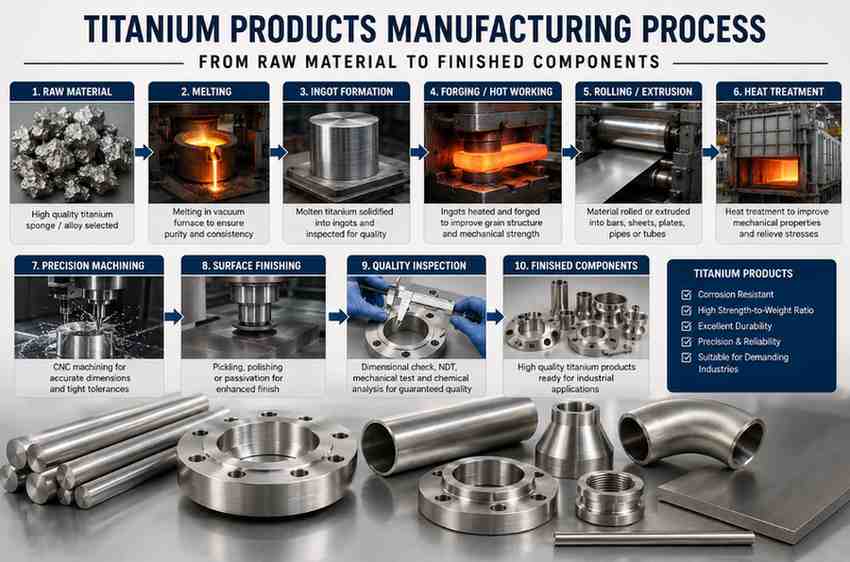
However, producing high-quality titanium products requires far more than simply shaping metal. Every stage of the manufacturing process—from selecting raw materials to melting, forming, machining, heat treatment, and quality inspection—must be carried out with precision to ensure the final product meets strict industrial standards.
At Virwadia Metal & Alloys, we manufacture and supply premium titanium products for demanding industrial applications. In this guide, we'll explain how titanium products are made and why each manufacturing step plays a vital role in delivering reliable, high-performance components.
What Are Titanium Products?
Titanium products are industrial components manufactured from commercially pure titanium or titanium alloys. Depending on the application, they are produced in a wide range of forms, including:
- Titanium bars
- Titanium round bars
- Titanium rods
- Titanium sheets
- Titanium plates
- Titanium pipes
- Titanium tubes
- Titanium flanges
- Titanium fittings
- Titanium fasteners
- Custom-machined titanium components
Each product is designed to provide excellent mechanical strength, corrosion resistance, and long service life in challenging environments.
Why Titanium Is Widely Used
Titanium offers a unique combination of properties that few engineering materials can match.
Key advantages include:
- Excellent corrosion resistance
- High strength with low weight
- Outstanding fatigue resistance
- Excellent performance at elevated temperatures
- Biocompatibility for medical applications
- Long operational life
- Low maintenance requirements
- Resistance to seawater and chemicals
These characteristics make titanium suitable for industries where safety, reliability, and performance are essential.
Step 1: Raw Material Selection
Every high-quality titanium product begins with carefully selected raw materials.
Manufacturers choose titanium sponge or certified titanium alloy feedstock that meets international material specifications. The quality of the raw material directly affects the strength, durability, and corrosion resistance of the finished product.
At this stage, suppliers verify:
- Chemical composition
- Material purity
- Alloy grade
- Traceability
- Certification compliance
Using certified raw materials helps ensure consistent product quality.
Step 2: Melting and Alloy Production
Titanium is highly reactive at elevated temperatures, so melting must take place in controlled environments.
Common melting technologies include:
- Vacuum Arc Remelting (VAR)
- Vacuum Induction Melting (VIM)
- Electron Beam Melting (EBM)
These advanced processes help:
- Remove impurities
- Improve chemical uniformity
- Enhance mechanical properties
- Produce defect-free titanium ingots
The result is a clean, high-quality material ready for further processing.
Step 3: Ingot Formation
After melting, molten titanium solidifies into large ingots.
Each ingot undergoes detailed inspection to verify:
- Internal soundness
- Surface quality
- Chemical consistency
- Dimensional accuracy
Only approved ingots move to the next stage of manufacturing.
Step 4: Hot Working and Forging
The titanium ingot is heated and shaped using controlled forging or rolling processes.
Hot working helps:
- Refine the grain structure
- Increase mechanical strength
- Improve toughness
- Eliminate internal defects
Depending on the desired product, manufacturers produce billets, slabs, or blooms for further processing.
Step 5: Rolling, Extrusion, and Forming
The forged material is transformed into different product forms through specialized manufacturing methods.
Rolling
Used to produce:
- Titanium sheets
- Titanium plates
- Titanium strips
Extrusion
Produces:
- Titanium rods
- Titanium bars
- Titanium profiles
Tube Manufacturing
Used to manufacture:
- Titanium pipes
- Titanium tubes
Each process ensures the product achieves the required dimensions and mechanical properties.
Step 6: Heat Treatment
Heat treatment improves the performance of titanium products by optimizing their internal structure.
Depending on the grade and application, manufacturers may perform:
- Annealing
- Stress relieving
- Solution treatment
- Aging
Benefits include:
- Improved ductility
- Enhanced strength
- Better machinability
- Increased dimensional stability
Step 7: Precision Machining
Many titanium products require precision machining before they are ready for industrial use.
Common machining operations include:
- CNC turning
- CNC milling
- Drilling
- Boring
- Threading
- Surface finishing
Because titanium is strong and generates heat during cutting, specialized tooling and machining techniques are used to maintain dimensional accuracy.
Step 8: Surface Finishing
Surface treatment improves both appearance and performance.
Depending on customer requirements, titanium products may undergo:
- Pickling
- Polishing
- Passivation
- Sandblasting
- Mechanical finishing
These processes remove surface contaminants and enhance corrosion resistance.
Step 9: Quality Inspection and Testing
Quality assurance is one of the most important stages of titanium manufacturing.
Each product undergoes rigorous inspection, including:
Dimensional Inspection
Ensures compliance with engineering drawings and specifications.
Chemical Analysis
Confirms the alloy composition matches industry standards.
Mechanical Testing
Evaluates:
- Tensile strength
- Yield strength
- Elongation
- Hardness
Non-Destructive Testing (NDT)
Methods such as ultrasonic and dye penetrant testing help detect internal or surface defects without damaging the product.
Surface Inspection
Checks for scratches, cracks, dents, or other imperfections.
Only products that meet strict quality requirements are approved for delivery.
Common Titanium Grades
Different industries require different titanium grades.
Grade 2 Titanium
Suitable for:
- Chemical processing
- Marine equipment
- Heat exchangers
Known for excellent corrosion resistance and weldability.
Grade 5 Titanium (Ti-6Al-4V)
Widely used in:
- Aerospace
- Defense
- Medical implants
- High-performance engineering
Offers exceptional strength and fatigue resistance.
Industries That Use Titanium Products
Titanium products are essential across many sectors.
These include:
- Aerospace
- Marine engineering
- Oil and gas
- Chemical processing
- Pharmaceutical manufacturing
- Food processing
- Power generation
- Medical equipment
- Automotive
- Desalination plants
Their durability and corrosion resistance make them ideal for demanding environments.
Why Manufacturing Quality Matters
High-quality manufacturing delivers measurable benefits:
- Longer product life
- Improved reliability
- Better corrosion resistance
- Higher safety standards
- Reduced maintenance
- Lower lifecycle costs
- Consistent performance
Investing in precision manufacturing helps businesses reduce downtime and improve operational efficiency.
Why Choose Virwadia Metal & Alloys?
Virwadia Metal & Alloys is a trusted manufacturer and supplier of premium titanium products for domestic and international industries.
Our strengths include:
- High-grade titanium raw materials
- Precision manufacturing processes
- Advanced fabrication capabilities
- Strict quality control
- Compliance with international standards
- Experienced technical team
- Custom dimensions and specifications
- Reliable delivery schedules
Whether you require titanium bars, sheets, plates, pipes, flanges, fittings, or custom components, we deliver products engineered for long-term performance.
Frequently Asked Questions
What are titanium products used for?
Titanium products are widely used in aerospace, marine, chemical processing, medical, power generation, food processing, and oil and gas industries because of their strength, corrosion resistance, and durability.
Why is titanium difficult to manufacture?
Titanium reacts with oxygen at high temperatures and requires specialized melting, machining, and heat-treatment processes to maintain its quality and performance.
Which titanium grade is most commonly used?
Grade 2 is commonly used for corrosion-resistant industrial applications, while Grade 5 (Ti-6Al-4V) is preferred for aerospace and high-strength engineering applications.
How is the quality of titanium products ensured?
Manufacturers conduct dimensional inspections, chemical analysis, mechanical testing, and non-destructive testing to verify product quality before delivery.
Why choose titanium over stainless steel?
Titanium offers a higher strength-to-weight ratio, excellent corrosion resistance, and superior performance in aggressive environments, making it ideal for critical industrial applications.
Final Thoughts
The manufacturing of titanium products is a highly controlled process that combines advanced metallurgy, precision engineering, and rigorous quality assurance. From selecting certified raw materials to melting, forging, machining, heat treatment, and final inspection, every step contributes to producing components that perform reliably in some of the world's most demanding environments.
Whether your project requires titanium bars, sheets, pipes, flanges, fittings, or custom-engineered components, choosing a trusted manufacturer is essential. Virwadia Metal & Alloys combines industry expertise, advanced manufacturing capabilities, and strict quality standards to deliver titanium products that meet the performance expectations of modern engineering and industrial applications.