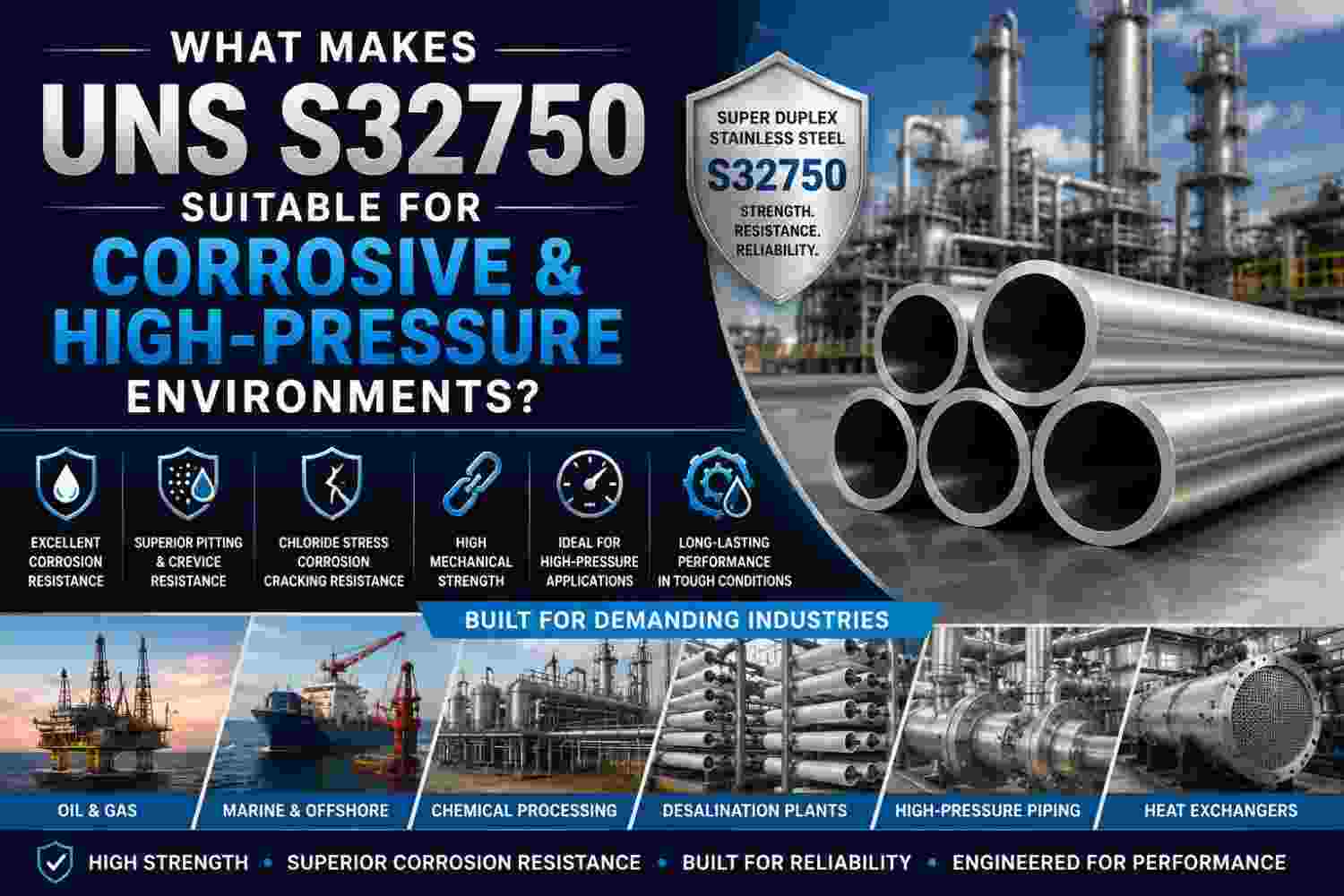
UNS S32750 is a super duplex stainless steel known for its high corrosion resistance, strong mechanical properties, and good resistance to chloride-related corrosion. These properties make it suitable for demanding environments where ordinary stainless steel grades may not provide the required combination of strength and corrosion protection.
It is commonly considered for applications in oil and gas, marine equipment, chemical processing, desalination, offshore systems, and high-pressure industrial equipment.
Selecting this grade, however, requires looking at the complete service environment, including temperature, pressure, chemical exposure, chloride concentration, fabrication requirements, and mechanical loading.
What Is UNS S32750 and Where Is It Used?
UNS S32750 is a super duplex stainless steel developed for applications requiring both high strength and excellent corrosion resistance.
It combines the characteristics of austenitic and ferritic stainless steels through its duplex microstructure.
This makes it suitable for demanding applications such as:
- Oil and gas equipment
- Offshore platforms
- Marine systems
- Chemical processing equipment
- Desalination plants
- Heat exchangers
- Pressure-containing components
- Industrial piping systems
Its combination of strength and corrosion resistance makes it particularly useful where equipment is exposed to aggressive operating conditions.
Why Is UNS S32750 Called Super Duplex Stainless Steel?
UNS S32750 is called a super duplex stainless steel because it offers higher corrosion resistance and strength than many conventional duplex stainless steels.
Its duplex structure contains both austenitic and ferritic phases.
This combination contributes to several important properties, including:
- High mechanical strength
- Excellent chloride resistance
- Good resistance to pitting
- Good resistance to crevice corrosion
- Resistance to chloride stress corrosion cracking
- Good overall corrosion performance
The balance between these properties makes the grade useful for demanding industrial environments.
How Does UNS S32750 Resist Corrosion?
UNS S32750 provides excellent corrosion resistance because of its alloy composition and balanced duplex structure.
Chromium, molybdenum, and nitrogen play important roles in its corrosion performance.
These alloying elements help the material resist different forms of localized corrosion that can occur in aggressive environments.
This is particularly valuable when components are exposed to:
- Salt water
- Chloride-containing fluids
- Chemical solutions
- Industrial process fluids
- Offshore environments
- Seawater-related applications
The actual corrosion performance depends on the specific service environment and operating conditions.
Why Is Pitting Resistance Important in Marine Applications?
Pitting resistance is important because chloride-containing environments can cause small localized areas of corrosion that may become difficult to detect and control.
Marine and offshore equipment can be exposed to seawater and chloride-rich conditions for long periods.
Pitting can compromise equipment by creating localized damage on the metal surface.
For this reason, materials used in marine environments often require strong resistance to localized corrosion.
UNS S32750 is particularly useful when pitting resistance is an important material-selection requirement.
Can UNS S32750 Handle Chloride-Rich Environments?
Yes, UNS S32750 is well suited to many chloride-rich environments because of its strong resistance to pitting, crevice corrosion, and chloride stress corrosion cracking.
Chlorides can be particularly aggressive toward stainless steels.
They may contribute to:
- Pitting
- Crevice corrosion
- Stress corrosion cracking
Super duplex stainless steel is often considered when these risks are important.
However, the exact suitability still depends on chloride concentration, temperature, flow conditions, contaminants, and other process variables.
What Is Chloride Stress Corrosion Cracking?
Chloride stress corrosion cracking occurs when tensile stress and a chloride-containing environment combine to cause cracking in susceptible materials.
This form of corrosion can be a serious concern in:
- Offshore equipment
- Chemical processing systems
- Seawater applications
- Industrial piping
- Heat exchangers
- Pressure equipment
UNS S32750 offers good resistance to chloride stress corrosion cracking, making it useful for selected applications where this failure mechanism is a concern.
How Strong Is Super Duplex Stainless Steel?
UNS S32750 provides significantly higher mechanical strength than many conventional austenitic stainless steels.
High strength can allow engineers to consider thinner sections in certain applications while still meeting design requirements.
The actual design, however, must always be based on applicable engineering codes and operating conditions.
Strength becomes particularly important in:
- High-pressure piping
- Offshore structures
- Pressure equipment
- Pumps
- Valves
- Process systems
High strength combined with corrosion resistance is one of the major advantages of super duplex stainless steel.
Why Is High Strength Important for Industrial Equipment?
High mechanical strength helps components withstand pressure, loads, and mechanical stresses during industrial operation.
Industrial equipment may experience:
- Internal pressure
- External loads
- Vibration
- Thermal stress
- Mechanical impact
- Continuous operating loads
A material with high strength can provide useful design flexibility when the application requires both structural performance and corrosion resistance.
Is UNS S32750 Suitable for Oil and Gas Applications?
Yes, UNS S32750 is widely considered for oil and gas applications because it combines high strength with resistance to aggressive and chloride-containing environments.
Potential applications include:
- Process piping
- Offshore equipment
- Valves
- Pumps
- Pressure components
- Heat exchangers
- Oil and gas processing systems
Offshore environments can be particularly demanding because equipment may encounter seawater, chlorides, pressure, and mechanical loads simultaneously.
Why Is UNS S32750 Used in Offshore Applications?
UNS S32750 is suitable for selected offshore applications because it can provide strong resistance to corrosion while maintaining high mechanical strength.
Offshore equipment must often withstand:
- Seawater exposure
- High humidity
- Chlorides
- Mechanical stress
- Pressure
- Long operating periods
Using a material with suitable corrosion resistance can help reduce maintenance requirements and extend equipment service life.
Material selection should still be based on the actual offshore environment and design conditions.
Is UNS S32750 Suitable for Desalination Plants?
Yes, UNS S32750 can be considered for desalination equipment exposed to seawater and chloride-rich process conditions.
Desalination systems can present challenging environments because of:
- High chloride content
- Seawater exposure
- Pressure
- Chemical treatment
- Continuous operation
Components may require a combination of corrosion resistance and mechanical strength.
Super duplex stainless steel can provide this combination for suitable applications.
Why Is Corrosion Resistance Important in Desalination?
Corrosion resistance is critical in desalination because seawater contains chlorides that can attack susceptible materials.
Corrosion can result in:
- Surface deterioration
- Pitting
- Leakage
- Reduced component life
- Increased maintenance
- Unexpected equipment failure
Selecting an appropriate material can help reduce these risks.
UNS S32750 is therefore considered for applications where resistance to seawater-related corrosion is important.
Can UNS S32750 Be Used for High-Pressure Equipment?
Yes, its high mechanical strength makes UNS S32750 suitable for certain high-pressure applications when the material and component design meet the required standards.
High-pressure equipment can include:
- Piping systems
- Valves
- Pumps
- Pressure vessels
- Process equipment
- Heat exchangers
The material grade alone does not determine pressure capability.
Engineers must also consider:
- Wall thickness
- Component dimensions
- Operating temperature
- Design pressure
- Welding
- Applicable design codes
- Safety factors
Is UNS S32750 Suitable for Chemical Processing?
UNS S32750 can be used in selected chemical-processing environments where strong corrosion resistance and mechanical strength are required.
Chemical processing equipment may encounter aggressive fluids and changing operating conditions.
Before selecting the grade, evaluate:
- Chemical composition
- Concentration
- Temperature
- Pressure
- Exposure duration
- Flow conditions
- Presence of chlorides
The grade should be selected only after confirming its compatibility with the specific chemical environment.
What Makes UNS S32750 Different From Standard Stainless Steel?
The major difference is the combination of a duplex microstructure, high mechanical strength, and superior resistance to several forms of localized corrosion.
Standard austenitic stainless steels may be suitable for many general-purpose applications, but more aggressive environments can require a higher level of corrosion resistance.
UNS S32750 may be considered when the application requires:
- Higher strength
- Better pitting resistance
- Better chloride resistance
- Resistance to stress corrosion cracking
- Long-term performance in demanding environments
The correct choice should always be based on actual service conditions.
What Is the Advantage of a Duplex Microstructure?
The duplex microstructure combines austenitic and ferritic phases to provide a balance of strength and corrosion resistance.
This combination gives duplex stainless steels characteristics that can be valuable in demanding applications.
The balanced structure contributes to:
- High strength
- Good corrosion resistance
- Resistance to chloride-related corrosion
- Useful toughness
- Industrial durability
This is one of the fundamental reasons super duplex grades are used in demanding environments.
Is UNS S32750 Resistant to Crevice Corrosion?
UNS S32750 provides strong resistance to crevice corrosion, making it useful for applications where stagnant or confined areas may be exposed to aggressive fluids.
Crevice corrosion can develop in areas such as:
- Joints
- Flanges
- Gaskets
- Fasteners
- Narrow gaps
- Connections
Marine and chemical-processing equipment can be particularly vulnerable to this type of corrosion.
The material's corrosion resistance can therefore be valuable when designing equipment with potential crevice locations.
Is UNS S32750 Suitable for Heat Exchangers?
Yes, UNS S32750 can be considered for certain heat exchanger applications where corrosion resistance and mechanical strength are important.
Heat exchangers may operate with:
- Seawater
- Chloride-containing fluids
- Chemical process fluids
- High pressures
- Elevated temperatures
The material should be selected after evaluating the fluid chemistry and thermal conditions.
In demanding environments, corrosion resistance can be just as important as heat-transfer performance.
What Should You Consider Before Choosing UNS S32750?
Before choosing UNS S32750, evaluate the complete operating environment rather than focusing only on corrosion resistance.
Important considerations include:
- Operating temperature
- Pressure
- Chloride concentration
- Chemical exposure
- Mechanical loading
- Flow conditions
- Welding requirements
- Product dimensions
- Applicable standards
- Expected service life
A complete assessment helps determine whether super duplex stainless steel is appropriate for the application.
Is UNS S32750 Suitable for Every Corrosive Environment?
No, UNS S32750 is highly corrosion resistant but should not be considered universally resistant to every chemical or operating environment.
Certain conditions can still affect the performance of the material.
These may include:
- Extremely aggressive chemicals
- Very high temperatures
- Specific acids
- Improper fabrication
- Poor welding practices
- Contamination
- Unsuitable heat treatment
Material compatibility should therefore be confirmed for the actual process conditions.
How Important Is Temperature When Selecting UNS S32750?
Temperature can significantly affect the corrosion resistance, mechanical properties, and long-term performance of super duplex stainless steel.
As operating temperature changes, engineers may need to reconsider:
- Strength
- Corrosion behavior
- Phase stability
- Pressure rating
- Welding considerations
- Long-term service performance
Therefore, the material should always be evaluated according to the complete temperature range rather than a single operating temperature.
Is Welding Important for UNS S32750?
Yes, welding is an important consideration because improper welding can affect the balance of the duplex microstructure and reduce the desired properties of the material.
Fabrication should use appropriate procedures for the grade and application.
Important factors include:
- Welding process
- Heat input
- Filler material
- Joint design
- Cooling conditions
- Post-weld requirements
For critical applications, qualified welding procedures and inspection practices should be followed.
How Can UNS S32750 Components Be Maintained?
Proper inspection, cleaning, operating control, and timely maintenance can help maintain the performance of UNS S32750 components.
Maintenance may include:
- Regular visual inspection
- Checking for localized corrosion
- Monitoring operating conditions
- Cleaning deposits
- Inspecting welded areas
- Checking pressure equipment
- Addressing damage promptly
Correct maintenance practices depend on the application and operating environment.
Why Is Material Certification Important for UNS S32750?
Material certification helps verify that the supplied alloy meets the required chemical composition, mechanical properties, dimensions, and applicable standards.
For industrial projects, buyers may require documentation such as:
- Mill Test Certificates
- Chemical analysis
- Mechanical test results
- Heat treatment records
- Inspection reports
- Applicable ASTM specifications
- EN standards
For critical applications, traceability can be an important part of quality control.
What Forms of UNS S32750 Are Available?
UNS S32750 can be supplied in different product forms depending on the requirements of the application.
Common forms can include:
- Plates
- Sheets
- Round bars
- Pipes
- Tubes
- Forged components
- Fittings
The required form depends on whether the material will be used for piping, pressure equipment, fabricated structures, machined parts, or other components.
How Do You Select the Right Product Form?
The right product form should be selected according to the component design, fabrication method, dimensions, and installation requirements.
For example:
Pipes and tubes may be suitable for process and fluid-handling systems.
Plates and sheets can be used for fabricated equipment and structural components.
Round bars can be suitable for machined components.
Forged products may be selected for specialized pressure or mechanical applications.
Understanding the final component design helps determine the appropriate material form.
Why Is UNS S32750 a Good Choice for Marine Applications?
UNS S32750 can be a strong material option for marine applications because of its resistance to chloride-containing environments and high mechanical strength.
Marine equipment can face constant exposure to:
- Seawater
- Salt
- Humidity
- Chlorides
- Pressure
- Mechanical loads
A material with strong resistance to localized corrosion can help improve reliability in these conditions.
What Are the Key Benefits of Super Duplex Stainless Steel?
The key benefits include high strength, strong resistance to localized corrosion, good chloride stress corrosion cracking resistance, and suitability for demanding industrial environments.
Its major advantages include:
- High mechanical strength
- Excellent corrosion resistance
- Good pitting resistance
- Good crevice corrosion resistance
- Strong chloride stress corrosion cracking resistance
- Suitability for marine environments
- Good performance in oil and gas applications
- Useful performance in chemical processing
These properties make it a valuable option for applications where both strength and corrosion resistance are required.
When Should You Consider UNS S32750?
UNS S32750 should be considered when an application requires a combination of high strength and strong resistance to aggressive, chloride-rich, or marine environments.
It may be worth evaluating for:
- Offshore equipment
- Oil and gas systems
- Desalination plants
- Marine equipment
- Chemical processing
- High-pressure piping
- Heat exchangers
- Industrial process equipment
The final material choice should always be based on the actual service environment.
Final Thoughts
UNS S32750 is a super duplex stainless steel designed for demanding applications where both corrosion resistance and mechanical strength are important.
Its resistance to pitting, crevice corrosion, and chloride stress corrosion cracking makes it particularly useful for challenging environments such as offshore facilities, marine systems, desalination plants, oil and gas equipment, and chemical processing.
Its high strength also makes it suitable for selected pressure-containing and mechanically demanding applications.
However, material selection should never rely on the grade name alone. Temperature, pressure, chemical composition, chloride exposure, fabrication method, welding, product form, and applicable standards should all be evaluated before purchasing.
For industries looking for super duplex stainless steel for corrosive environments, understanding the operating conditions and verifying the required material specifications can help ensure better performance and long-term reliability.