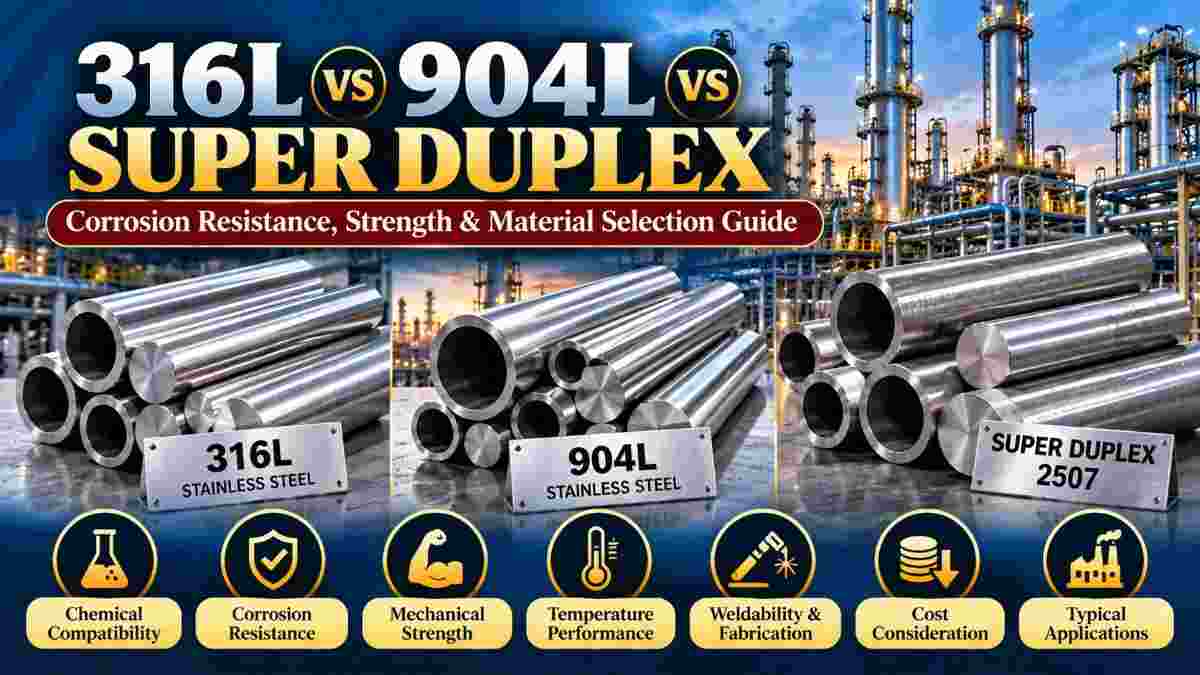
Are you selecting stainless steel for chemical processing, marine equipment, industrial piping, or corrosive fluid handling? Choosing the wrong material can lead to premature corrosion, maintenance costs, and equipment downtime.
The choice between 316L, 904L, and super duplex stainless steel depends on chemical composition, chloride concentration, operating temperature, pressure, mechanical strength, and fabrication requirements.
316L is widely considered for moderately corrosive environments, 904L offers improved resistance in certain aggressive acidic conditions, and super duplex stainless steel provides high strength with excellent resistance to many chloride-containing environments.
Virwadia Metal & Alloys supplies stainless steel and specialty alloy products for industrial applications.
What Is 316L Stainless Steel?
316L is a low-carbon austenitic stainless steel containing chromium, nickel, and molybdenum, commonly selected for corrosion resistance and welded fabrication.
Its low carbon content helps reduce sensitization risks during suitable welding operations.
Typical applications include:
-
Chemical processing equipment.
-
Industrial pipelines.
-
Heat exchangers.
-
Pharmaceutical equipment.
-
Food processing machinery.
-
General engineering components.
Explore 316L Stainless Steel Seamless Pipes for product information.
What Is 904L Stainless Steel?
904L is a high-alloy austenitic stainless steel containing increased nickel and molybdenum, with copper added to improve resistance in certain acidic environments.
It is identified as UNS N08904.
904L is often considered for:
-
Chemical processing plants.
-
Acid-handling equipment.
-
Fertilizer manufacturing.
-
Industrial heat exchangers.
-
Selected marine applications.
Explore 904L Stainless Steel for available product information.
What Is Super Duplex Stainless Steel?
Super duplex stainless steel combines austenitic and ferritic microstructures to provide high mechanical strength and excellent resistance to several forms of localized corrosion.
Common grades include UNS S32750 and UNS S32760.
Typical applications include:
Material suitability depends on the specific super duplex grade and operating conditions.
What Is the Main Difference Between 316L, 904L, and Super Duplex?
The main differences involve alloy composition, corrosion behavior, mechanical strength, and fabrication requirements.
-
316L: A commonly used molybdenum-bearing austenitic grade for suitable industrial environments.
-
904L: A higher-alloy austenitic grade often selected for certain aggressive acidic conditions.
-
Super Duplex: A dual-phase stainless steel offering high strength and strong resistance to chloride-induced localized corrosion.
All three require application-specific evaluation.
Which Stainless Steel Has Better Chloride Corrosion Resistance?
904L and super duplex 2507 generally offer greater resistance to chloride-induced pitting than conventional 316L, but their performance depends on the environment and product condition.
Chloride corrosion risks increase with factors such as:
Super duplex 2507 is frequently considered for aggressive seawater environments.
However, corrosion resistance should be verified using relevant testing and service data.
Which Grade Is Better for Acidic Chemical Environments?
904L can offer advantages in certain acidic solutions, while super duplex alloys may perform better under other chemical conditions.
Important selection factors include:
No stainless steel grade is universally resistant to every acid.
Request material compatibility information for the actual process fluid.
Which Stainless Steel Offers Higher Mechanical Strength?
Super duplex stainless steel generally provides significantly higher yield strength than annealed 316L and 904L.
Higher strength may allow engineers to consider different component dimensions where permitted by the design code.
However, the final design must also consider:
-
Pressure.
-
Temperature.
-
Corrosion allowance.
-
Weld efficiency.
-
Fatigue.
-
Applicable standards.
Higher strength alone does not guarantee better overall material suitability.
Which Is Better for Seawater and Marine Applications?
Super duplex 2507 is frequently considered for demanding seawater applications because of its resistance to chloride-related corrosion and high mechanical strength.
316L may be unsuitable for prolonged exposure to aggressive warm or stagnant seawater.
904L provides improved corrosion resistance in certain environments but is not automatically the best choice for every seawater application.
Material selection should consider seawater temperature, oxygen, chlorination, crevices, and operating conditions.
How Do Welding Requirements Affect Material Selection?
Welding requirements affect alloy selection because improper procedures can reduce corrosion resistance and mechanical performance.
316L and 904L are austenitic grades commonly used in welded fabrication.
Super duplex stainless steel requires careful control of:
-
Heat input.
-
Interpass temperature.
-
Filler material.
-
Shielding.
-
Phase balance.
-
Post-weld inspection.
Use qualified welding procedures appropriate to the selected alloy.
How Do You Compare the Cost of 316L, 904L, and Super Duplex?
Material costs vary with alloy composition, product form, dimensions, supply conditions, manufacturing processes, and market availability.
316L is commonly a more economical starting point where its corrosion resistance is sufficient.
904L and super duplex materials may involve higher initial costs.
However, buyers should also assess:
The lowest purchase price does not necessarily provide the lowest lifetime cost.
What Specifications Should You Check Before Purchasing?
Buyers should verify material grade, product standard, dimensions, operating conditions, inspection requirements, and traceability before placing an order.
A practical checklist includes:
-
Grade: 316L, 904L, S32750, or S32760.
-
Product form: Pipe, tube, plate, or round bar.
-
Dimensions: Diameter, thickness, or section size.
-
Specification: Applicable ASTM, ASME, or EN standard.
-
Process fluid: Chemical composition and concentration.
-
Temperature: Normal and maximum conditions.
-
Pressure: Design and operating conditions.
-
Fabrication: Welding and forming requirements.
-
Testing: Required inspection methods.
-
Documentation: Material Test Certificate and heat-number traceability.
-
Quantity: Required amount.
-
Delivery: Location and schedule.
These details help suppliers prepare an accurate quotation.
Why Should Buyers Consider Virwadia Metal & Alloys?
Virwadia Metal & Alloys supplies stainless steel and specialty alloy products for industrial sourcing requirements.
Its product portfolio covers stainless steel grades including 316L and 904L, as well as duplex and super duplex materials.
Buyers can explore 316L Seamless Pipes and 904L Stainless Steel.
Confirm exact grade availability, product dimensions, technical documentation, and commercial terms before ordering.
What Are the Most Frequently Asked Questions About Corrosion-Resistant Stainless Steel?
Common questions concern chloride resistance, acid exposure, strength, welding, and material substitution.
Is 904L Better Than 316L?
904L provides improved resistance in several corrosive environments, but 316L may be sufficient and more economical for less demanding applications.
Is Super Duplex Stronger Than 904L?
Super duplex stainless steel generally has significantly higher yield strength than annealed 904L.
Which Stainless Steel Is Best for Seawater?
Super duplex grades such as 2507 are frequently considered for aggressive seawater applications, subject to engineering evaluation.
Can 904L Replace Super Duplex Stainless Steel?
Not automatically. Differences in strength, corrosion performance, and design requirements require engineering approval.
Is 316L Suitable for Chemical Processing?
Yes, for compatible chemical environments. Suitability depends on concentration, temperature, contamination, and equipment design.
Do All Three Grades Require Material Test Certificates?
Material documentation should be specified according to the purchase order, applicable standard, and project quality requirements.
How Can You Request Corrosion-Resistant Stainless Steel From Virwadia Metal & Alloys?
You can request a quotation by providing the required grade, dimensions, material standard, process conditions, quantity, and inspection requirements.
Selecting between 316L, 904L, and super duplex stainless steel requires balancing corrosion performance, mechanical strength, fabrication needs, and procurement costs.
Explore 316L Stainless Steel Seamless Pipes, 904L Stainless Steel, or contact Virwadia Metal & Alloys for technical enquiries and quotations.
Technical Note: Final alloy selection should be based on the actual process chemistry, operating conditions, applicable design standards, qualified corrosion data, and approved engineering specifications.