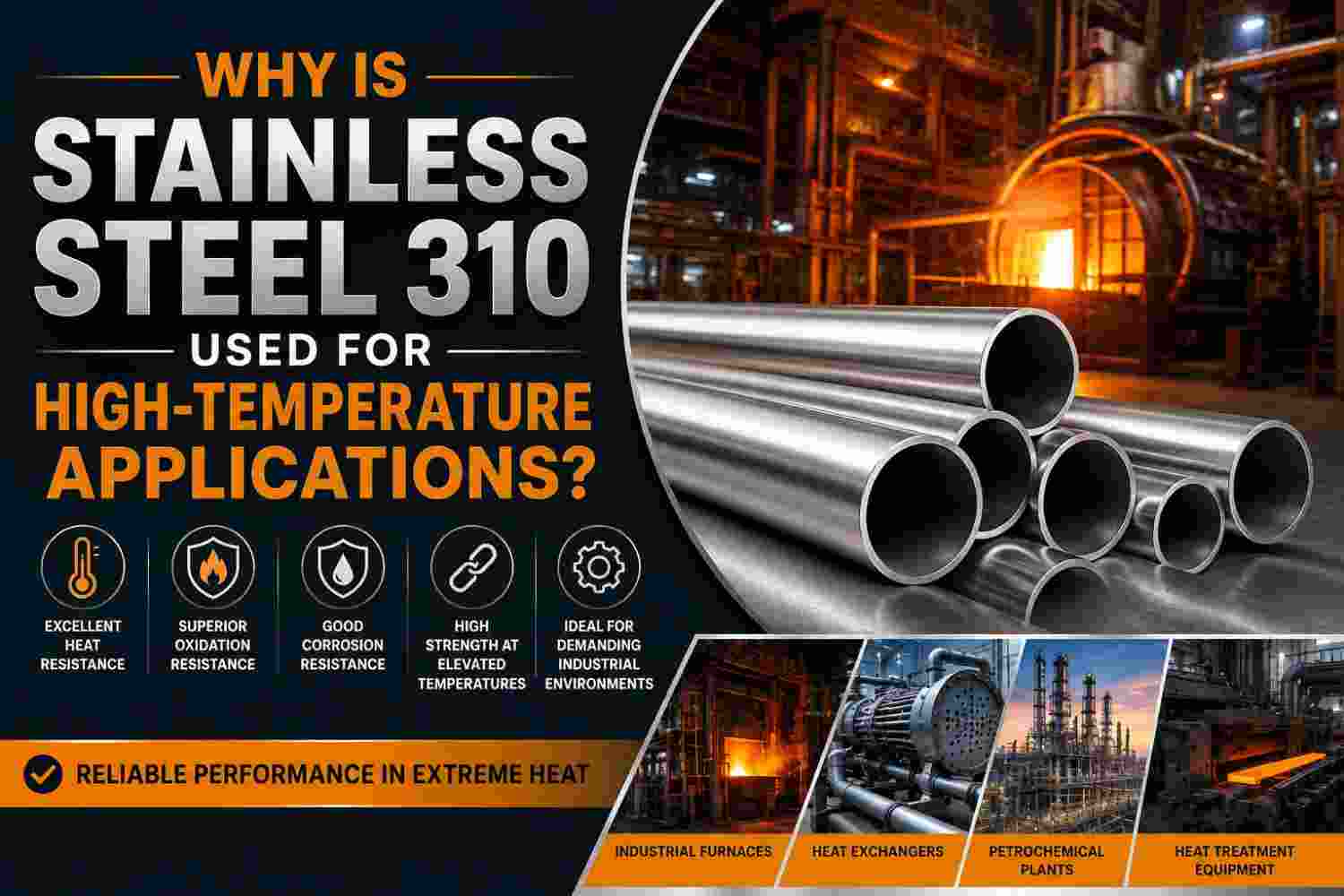
Stainless Steel 310 is widely used for high-temperature applications because it offers excellent oxidation resistance, good corrosion resistance, and strong performance under elevated temperatures. Its high chromium and nickel content helps the material withstand demanding thermal environments where ordinary stainless steel grades may not be suitable.
This makes SS 310 a practical material for industrial furnaces, heat treatment equipment, heat exchangers, petrochemical systems, power generation equipment, and other applications exposed to high heat.
What Makes Stainless Steel 310 Suitable for High Temperatures?
The high chromium and nickel content of Stainless Steel 310 gives it excellent resistance to oxidation and helps maintain its performance at elevated temperatures.
SS 310 is an austenitic stainless steel designed for applications where heat resistance is an important requirement.
Its properties make it suitable for environments involving:
- High operating temperatures
- Thermal cycling
- Oxidizing atmospheres
- Mechanical stress
- Long periods of heat exposure
For industrial equipment operating under demanding thermal conditions, material selection is especially important because excessive heat can reduce strength and accelerate oxidation.
How Does SS 310 Resist Oxidation?
SS 310 resists oxidation because its high chromium content helps form a protective oxide layer on the surface.
When stainless steel is exposed to elevated temperatures and oxygen, oxidation can cause surface deterioration. Chromium helps create a protective layer that slows down further oxidation.
This characteristic makes SS 310 useful for components such as:
- Furnace parts
- Heat shields
- Radiant tubes
- Industrial ovens
- Heat treatment equipment
- High-temperature components
Oxidation resistance is one of the key reasons this grade is selected for high-heat industrial applications.
Can Stainless Steel 310 Handle Extreme Heat?
Yes, Stainless Steel 310 is specifically developed for applications where materials are exposed to high temperatures.
Its high-temperature performance allows it to be considered for demanding thermal environments.
However, the actual operating limit depends on several factors, including:
- Temperature
- Exposure duration
- Atmospheric conditions
- Mechanical load
- Component design
- Thermal cycling
- Corrosive environment
Therefore, the maximum temperature capability should not be considered a universal operating temperature for every application.
Why Is Chromium Important in SS 310?
Chromium is one of the most important elements responsible for the oxidation and corrosion resistance of Stainless Steel 310.
A high chromium content helps the alloy develop a protective surface layer.
This becomes particularly valuable when equipment is exposed to:
- High temperatures
- Oxygen
- Moisture
- Industrial gases
- Thermal cycling
The combination of chromium with other alloying elements gives SS 310 its characteristic high-temperature performance.
How Does Nickel Improve the Performance of SS 310?
Nickel helps stabilize the austenitic structure of SS 310 and contributes to its corrosion resistance and high-temperature performance.
The combination of chromium and nickel gives the alloy a useful balance of properties for demanding applications.
These include:
- High-temperature strength
- Oxidation resistance
- Corrosion resistance
- Structural stability
- Good fabrication characteristics
This combination is particularly valuable when equipment must operate for extended periods under elevated temperatures.
Does SS 310 Maintain Strength at High Temperatures?
SS 310 can retain useful mechanical strength under elevated-temperature conditions, making it suitable for components that experience both heat and mechanical stress.
This can be important for equipment that must support loads while operating at high temperatures.
Potential applications include:
- Furnace components
- Heat treatment equipment
- Industrial ovens
- Radiant tubes
- Thermal processing equipment
The actual strength at a particular temperature depends on the operating conditions and component design.
What Is Creep Resistance and Why Does It Matter?
Creep resistance is the ability of a material to resist gradual deformation when exposed to sustained stress at elevated temperatures.
At high temperatures, metals can slowly deform even when the applied load remains constant.
Creep resistance becomes important for components that:
- Operate continuously at high temperatures
- Carry mechanical loads
- Remain under stress for long periods
- Need to maintain their shape
For high-temperature industrial equipment, creep behavior should therefore be considered during material selection.
Is SS 310 Suitable for Furnace Applications?
Yes, SS 310 is commonly considered for furnace components because of its resistance to oxidation and high-temperature degradation.
It can be used for selected furnace components such as:
- Furnace supports
- Heat shields
- Radiant tubes
- Furnace parts
- Heating equipment components
The correct material should be selected according to furnace temperature, atmosphere, load, and operating cycle.
Why Is SS 310 Used in Heat Treatment Equipment?
SS 310 is useful for selected heat treatment applications because it can withstand high temperatures and repeated thermal exposure.
Heat treatment equipment may experience repeated heating and cooling cycles, which can place considerable thermal stress on components.
SS 310 can be considered for components that require:
- High-temperature resistance
- Oxidation resistance
- Dimensional stability
- Resistance to thermal cycling
The specific application should always be evaluated according to actual operating conditions.
Is Stainless Steel 310 Suitable for Heat Exchangers?
SS 310 can be used in selected heat exchanger applications where high-temperature performance is required.
When selecting stainless steel for a heat exchanger, engineers should consider more than temperature alone.
Important factors include:
- Fluid composition
- Operating pressure
- Temperature
- Corrosion conditions
- Heat transfer requirements
- Tube or plate design
- Maintenance requirements
The correct stainless steel grade depends on the complete service environment.
Is SS 310 Suitable for Petrochemical Equipment?
Yes, SS 310 can be used in certain petrochemical and refinery applications where high temperatures and demanding process conditions are present.
Possible applications include:
- Furnace equipment
- High-temperature piping
- Thermal processing components
- Refinery equipment
- Heat-related process systems
However, chemical compatibility must always be evaluated because different process chemicals can affect stainless steel differently.
Can SS 310 Be Used in Chemical Processing?
SS 310 can be suitable for certain chemical-processing applications when the temperature and chemical environment are compatible with the alloy.
Before selecting SS 310, consider:
- Chemical concentration
- Operating temperature
- Pressure
- Exposure duration
- Chloride content
- Oxidizing conditions
- Reducing conditions
No stainless steel grade is resistant to every chemical environment, so application-specific material selection is important.
Is SS 310 Suitable for Power Generation Applications?
SS 310 can be considered for selected power-generation applications that involve elevated temperatures and oxidation-resistant components.
Depending on the equipment design, it may be used in:
- Thermal equipment
- Heat-related components
- High-temperature piping
- Furnace systems
- Heat exchangers
The appropriate grade and product form should be selected based on the operating conditions of the equipment.
What Forms of SS 310 Are Available?
Stainless Steel 310 is available in several product forms to suit different fabrication and engineering requirements.
Common forms include:
- Stainless steel sheets
- Stainless steel plates
- Stainless steel pipes
- Stainless steel tubes
- Stainless steel round bars
The appropriate form depends on the application.
For example, sheets and plates may be used for fabricated components, while pipes and tubes can be suitable for process systems.
What Are the Mechanical Properties of SS 310?
SS 310 offers a useful combination of tensile strength, yield strength, elongation, and hardness for demanding industrial applications.
Typical specifications may include:
- Tensile strength
- Yield strength
- Elongation
- Hardness
The exact mechanical properties depend on the applicable standard, product form, heat treatment, and manufacturing condition.
For critical industrial projects, buyers should always verify the material test certificate and applicable specification.
Is Stainless Steel 310 Weldable?
Yes, Stainless Steel 310 has good weldability when appropriate welding procedures and materials are used.
Welding performance depends on:
- Welding process
- Material thickness
- Joint design
- Filler material
- Heat input
- Fabrication procedure
For industrial equipment, welding should follow suitable engineering procedures and applicable standards.
What Is the Difference Between SS 310 and SS 310S?
SS 310 and SS 310S have similar high-temperature characteristics, but SS 310S has a lower carbon content.
The lower carbon content of SS 310S can make it a preferred option for certain welded fabrications.
The choice between the two depends on:
- Welding requirements
- Operating temperature
- Fabrication method
- Creep requirements
- Application standards
Neither grade should automatically be considered better than the other. The correct choice depends on the application.
When Should You Consider SS 310H?
SS 310H can be considered for applications where high-temperature strength and creep performance are particularly important.
It may be appropriate for prolonged high-temperature service where the material must maintain its mechanical properties under continuous thermal stress.
Before selecting SS 310H, consider:
- Operating temperature
- Exposure duration
- Mechanical loading
- Pressure
- Creep requirements
- Applicable standards
How Do You Choose Between SS 310, 310S, and 310H?
The choice should be based on temperature, welding requirements, creep exposure, component design, and applicable material standards.
Consider the following factors:
- Maximum operating temperature
- Continuous or intermittent operation
- Welding requirements
- Carbon content
- Mechanical loading
- Creep resistance
- Pressure conditions
- Product form
For critical applications, technical specifications should be reviewed before final material selection.
What Should You Consider Before Selecting SS 310?
Before selecting SS 310, evaluate the complete operating environment rather than focusing only on temperature resistance.
Important considerations include:
- Operating temperature
- Thermal cycling
- Mechanical stress
- Chemical exposure
- Pressure
- Creep requirements
- Welding requirements
- Product dimensions
- Applicable standards
- Expected service life
This helps ensure that the selected material is suitable for the actual application.
Why Is Material Certification Important?
Material certification helps confirm that the supplied stainless steel meets the required chemical, mechanical, and dimensional specifications.
For industrial projects, buyers may require documents such as:
- Mill Test Certificates
- Material inspection reports
- Chemical composition reports
- Mechanical test results
- Applicable ASTM specifications
- ASME requirements
- EN standards
For critical applications, traceability and certification can be particularly important.
How Do You Select the Right SS 310 Product Form?
The right product form depends on how the stainless steel will be fabricated, machined, welded, or installed.
For example:
Sheets and plates can be suitable for fabricated equipment, heat shields, and structural components.
Round bars can be used for machined parts and engineering components.
Pipes and tubes can be suitable for high-temperature fluid and process systems.
Choosing the correct product form can simplify fabrication and installation.
Is SS 310 a Good Choice for Every High-Temperature Application?
No, SS 310 is not automatically the best material for every high-temperature application.
Material selection should also consider:
- Chemical environment
- Chloride exposure
- Pressure
- Temperature range
- Creep requirements
- Thermal cycling
- Fabrication requirements
- Budget
- Required service life
In some applications, other stainless steel grades or nickel-based alloys may provide better performance.
How Can You Improve the Service Life of SS 310 Components?
Proper material selection, correct fabrication, appropriate installation, and controlled operating conditions can help extend the service life of SS 310 components.
Good practices include:
- Staying within recommended operating conditions
- Using appropriate welding procedures
- Following applicable standards
- Performing regular inspections
- Monitoring corrosion or oxidation
- Avoiding unnecessary thermal shock
- Replacing severely damaged components
Material quality alone cannot compensate for incorrect application or poor maintenance.
Where Is High-Temperature Stainless Steel Used?
High-temperature stainless steel is used in industries where equipment must withstand elevated temperatures while maintaining useful strength and corrosion resistance.
Common applications include:
- Industrial furnaces
- Heat treatment plants
- Petrochemical facilities
- Refineries
- Power plants
- Heat exchangers
- Industrial ovens
- Thermal processing equipment
- Chemical processing plants
SS 310 is particularly useful when oxidation resistance and high-temperature performance are major requirements.
Why Is SS 310 a Practical Choice for Industrial Applications?
The combination of heat resistance, oxidation resistance, corrosion resistance, mechanical strength, and fabrication capability makes SS 310 a practical option for many demanding industrial applications.
Its performance can make it suitable for equipment exposed to high temperatures where ordinary stainless steel may not provide the required level of resistance.
However, the grade should always be selected according to actual service conditions.
For businesses looking for high-temperature stainless steel for industrial applications, it is important to evaluate the grade, product form, dimensions, specifications, and certification before purchasing.
Final Thoughts
Stainless Steel 310 is a specialized austenitic stainless steel designed for applications where high temperature and oxidation resistance are important.
Its chromium and nickel content provides the properties needed for demanding environments such as furnaces, heat treatment systems, heat exchangers, petrochemical facilities, refineries, and thermal processing equipment.
However, choosing SS 310 should not be based on temperature alone. Chemical exposure, mechanical loading, pressure, thermal cycling, creep requirements, welding, product form, and applicable standards should also be considered.
SS 310, SS 310S, and SS 310H can serve different application requirements. Understanding these differences helps engineers and buyers select a grade that matches the actual operating environment.
For industries seeking high-temperature stainless steel for industrial applications, careful material selection and proper certification can help achieve reliable performance and long-term value.